Every tackle shop has a wall of carp flavours. Strawberry, scopex, banana, garlic, caramel, krill. Every angler at the dam has a "secret" mix for the pap. Some of it works, a lot of it is habit, and almost none of it has been explained to you.
Scientists have spent decades studying how carp find and choose food. They have counted the taste buds on a carp's lips, recorded the nerves that carry taste to its brain, and tested carp with hundreds of pellets flavoured one substance at a time. They have also tracked wild carp to bait in a lake, night by night.
This guide turns that research into plain language and practical choices for the papgooi angler. We mark how sure the science is as we go. Where something is measured and repeated, we say so. Where it rests on one study, or on our own reasoning, we say that too.
In 30 seconds
- Three checks. A carp smells your bait from a distance, tastes it with its lips and barbels, then tastes it again inside its mouth before it swallows or spits.
- Carp are covered in taste buds. Up to about 820 per square millimetre on the roof of the mouth, one of the highest densities measured in any fish.
- Sour beats sweet. In taste tests, citric acid more than doubled how many pellets carp ate. Plain sugar (sucrose) and plain salt made no difference.
- Smell draws them in, taste makes them eat. These are two different jobs, and a good bait needs both.
- Carp learn bait. Wild carp found a new food spot in days, and in one river study the best flavour changed during a single summer as local anglers fed the fish.
Sign in to keep reading
Create a free AnglersHub account or sign in to read more of this guide. The full guide is part of AnglersHub Pro.
You come straight back to this guide afterwards.
A fish that tastes with its face
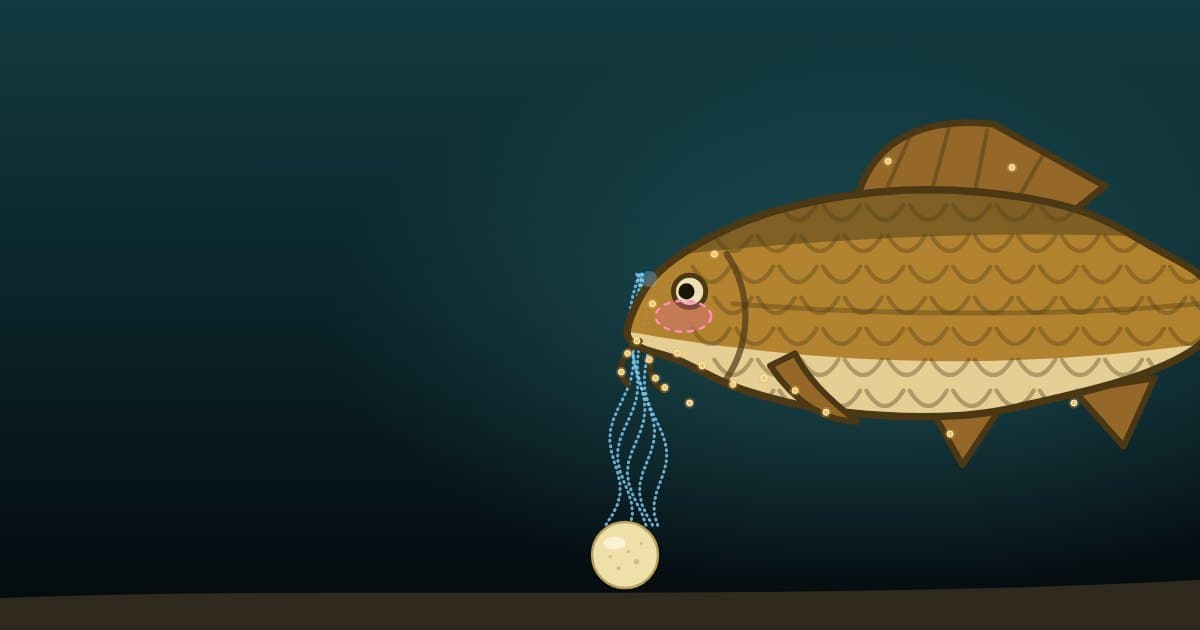
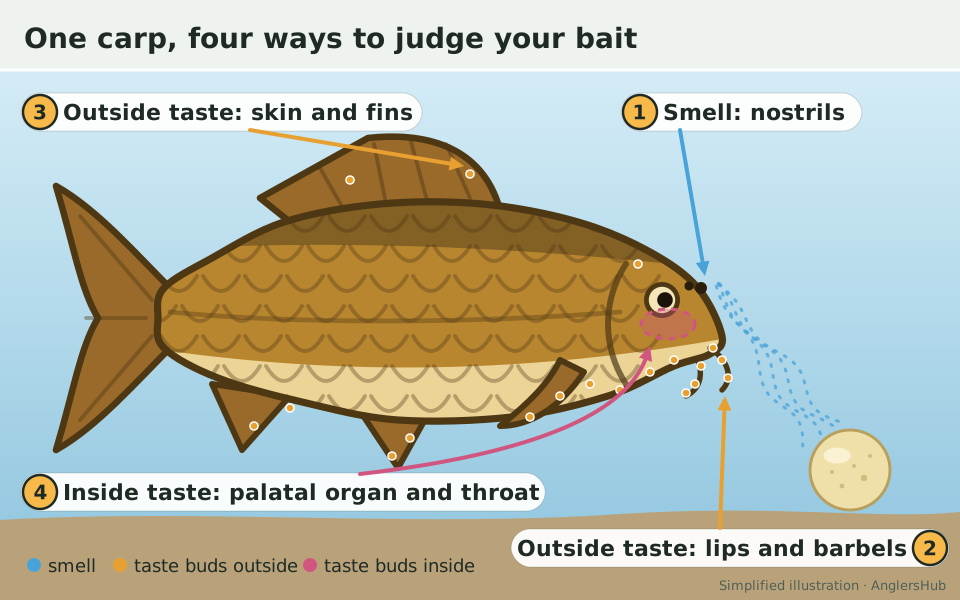
A carp has three food senses, not one. It smells with two small nostrils on top of its snout. It tastes with taste buds on the outside of its body. And it tastes again with taste buds inside its mouth and throat.
The numbers are huge
The most detailed study of the carp mouth was done at Wageningen University in the Netherlands. Frans Sibbing counted the taste buds on carp under the microscope and found very high densities on the barbels and lips, and even higher ones inside (Sibbing, 1984).
~380 taste buds per mm² on the lips and barbels
Up to 820 per mm² on the palatal organ and throat
To picture 380 per square millimetre: a patch of lip the size of a pinhead holds hundreds of taste buds. Sibbing noted that the density on the palatal organ is close to the most that is physically possible, and far above values reported for other fish. (Strong evidence: counted directly. The 380 figure for lips and barbels is given as an approximate value.)
The palatal organ: a sorting machine
The roof of a carp's throat is a thick, muscular pad called the palatal organ. It is packed with taste buds.
A feeding carp sucks up mud, sand and food together. The palatal organ and the gill rakers then hold back what tastes like food and let the rest wash out through the gills. Sibbing showed that this lets carp separate food from non-food even when it is mixed into sediment (Sibbing, 1988). This is why feeding carp send up clouds of silt and bubbles. (Strong evidence.)
What this means on the bank: a carp does not need to see your bait to find it, and it does not swallow everything it sucks in. Its mouth is a tasting lab. Your bait passes or fails in there.
Keep reading with AnglersHub Pro
The other 10 sections of this guide are for Pro members. Pro also unlocks Billy the Bot, Fish ID, the live weather map and your personal bite windows.