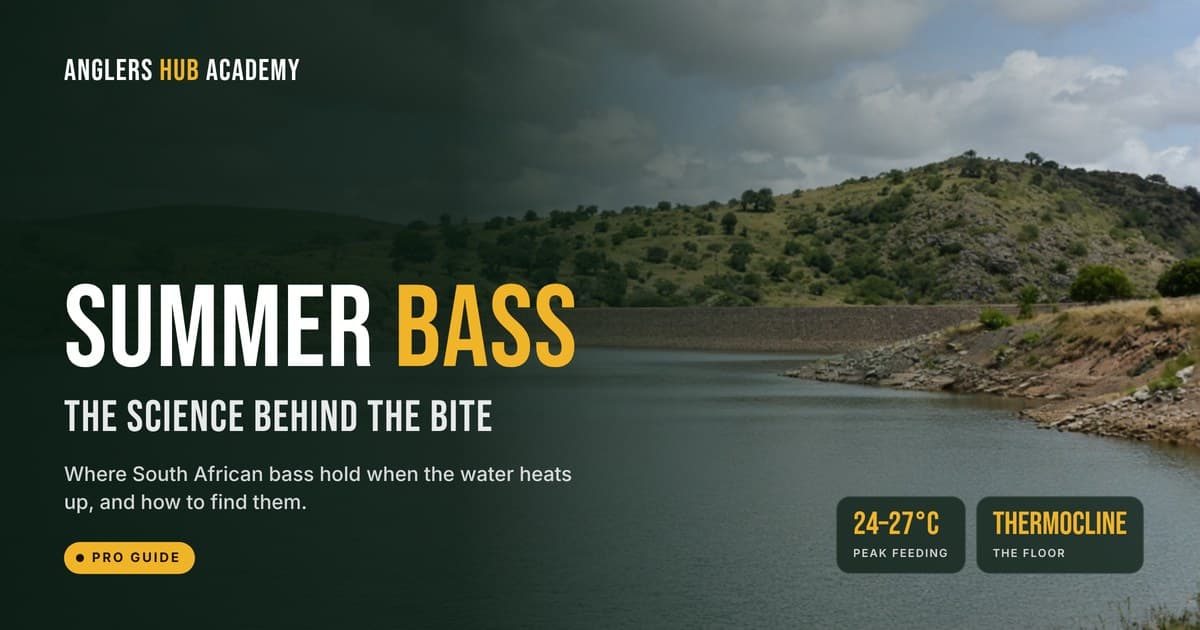
Summer should be the easiest time of year to catch a bass. The water is warm, the fish are hungry and the days are long. Yet every December the same story comes back from dams across the country: a few fish at first light, then nothing for eight hours. The bass did not leave. They are doing exactly what their bodies tell them to do in hot water, and once you understand why, you stop fishing where they were and start fishing where they have to be.
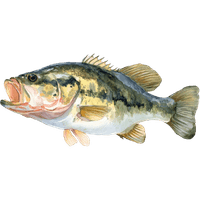
This guide explains the science behind summer bass behaviour in South Africa, from November to February. It covers what heat does to a cold-blooded fish, why most of your dam is off limits to bass in summer, the daily oxygen cycle in green water, light, storms and rising water, what bass are eating, and how all of it turns into a plan for your next trip. It focuses on largemouth bass, with notes on smallmouth and spotted bass where they behave differently.
Facts in this guide are marked by how sure the science is. Where something is well proven, we say so. Where it is one study, or angler experience, we say that too.
Sign in to keep reading
Create a free AnglersHub account or sign in to read more of this guide. The full guide is part of AnglersHub Pro.
You come straight back to this guide afterwards.
Why summer changes everything: a cold-blooded fish in a hot dam
A bass cannot make its own heat. Its body is the same temperature as the water around it, so water temperature sets the speed of everything inside it: how fast it digests, how fast it swims, how much oxygen it burns and how often it needs to eat.
The engine runs faster
As a rule of thumb from fish physiology, the rate of most body processes in a fish roughly doubles to triples for every 10 °C rise in temperature, until the fish gets close to its upper limit. A bass in 26 °C water is burning energy far faster than the same fish in a 12 °C winter dam. That has two results you can fish with:
- Bass digest fast in summer. In feeding studies the rate at which a bass empties its stomach rises steeply (exponentially) with temperature (Cochran and Adelman, 1982). A meal that takes days to clear in winter clears in a fraction of that time in summer, so the fish is ready to eat again sooner.
- Bass eat more in summer. In the same study, the daily ration of young largemouth climbed from almost nothing around spawning time to more than 5% of their body weight per day by late summer. At that rate, a 2 kg bass would need about 100 g of food every day.
The sweet spot, and the ceiling
Largemouth bass do best in roughly 20 to 30 °C water. In US Fish and Wildlife habitat models, young bass grew fastest at about 26 to 28 °C, with the best food conversion close to 27 °C (Stuber and others, 1982). The AnglersHub Bite Score puts the bass peak at about 24 °C water, because that is where activity and comfort overlap best for adult fish in our dams.
Above the high 20s, the picture changes. The fish's oxygen demand keeps rising, but warm water holds less oxygen. At full saturation, water at 32 °C holds about 7.4 mg of oxygen per litre, compared with about 11.9 mg/L at 7 °C (University of Florida IFAS). So the hotter it gets, the more oxygen a bass needs, and the less there is. That squeeze is the key to everything else in this guide.
In summer a bass is a hungry fish with a fast engine and a short fuel line. It wants to eat, but only where the water lets it breathe.
South African summers make this sharper than most. Highveld dams such as Vaal, Hartbeespoort and Bronkhorstspruit commonly reach the mid to high 20s at the surface by December, and Lowveld and KZN waters run hotter still. Your AnglersHub forecast estimates water temperature from the last few days of air temperature, which is a good first clue before you leave home.
Keep reading with AnglersHub Pro
The other 14 sections of this guide are for Pro members. Pro also unlocks Billy the Bot, Fish ID, the live weather map and your personal bite windows.