Almost every South African angler caught a kurper first. They live in nearly every warm dam, bite in daylight and fight hard for their size. Catching a big kurper, a fish of a kilogram or more, is a different game, and summer is the time to do it.
Kurper breed again and again through the warm months. That makes them easy to find, because you can see where they nest, but it also means they behave very differently from other fish. This guide shows how to tell the kurper apart, what they do in summer, where the big ones wait and how to catch them on light tackle. It doubles as the perfect guide for taking kids fishing over the December holidays.
In 30 seconds
- Kurper breed all summer in warm, shallow bays. Look for round, pale nests on the bottom.
- The big ones sit just off the nests, on the first drop-off in 1 to 3 m of water.
- Fish light: a small float, a size 10 to 14 hook and a small worm or bread.
- Kurper feed in daylight, best from mid-morning once the shallows warm up.
- Look after nesting and mouthbrooding fish, and never move live kurper to other waters.
Facts are marked by how sure the science is. Where something is well proven, we say so. Where it is angler experience, we say that too.
Sign in to keep reading
Create a free AnglersHub account or sign in to read more of this guide. The full guide is part of AnglersHub Pro.
You come straight back to this guide afterwards.
Know your kurper
"Kurper" covers a few different fish. These are the ones South African anglers catch most, plus one you should learn to recognise.
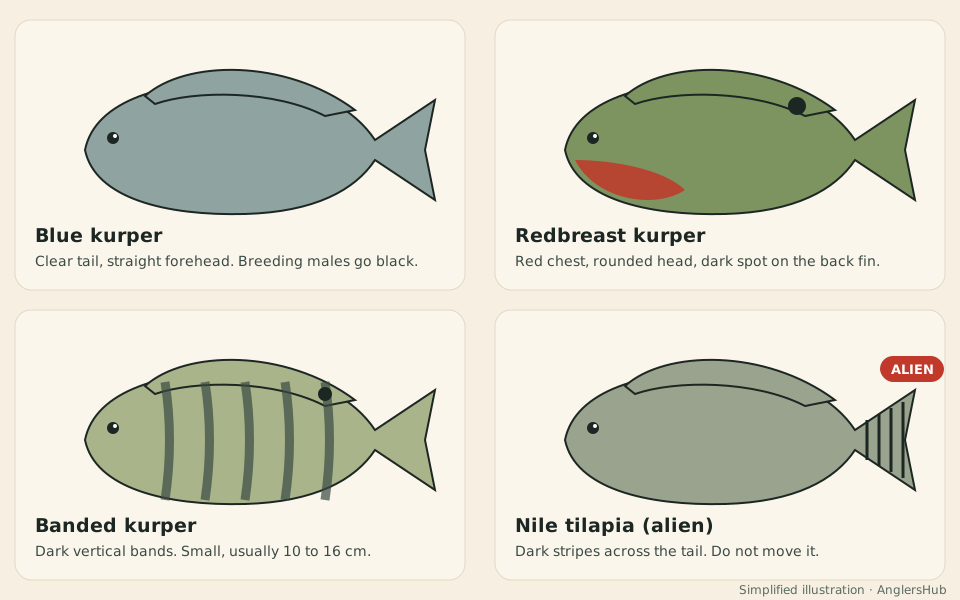
Blue kurper (Mozambique tilapia)
- Scientific name: Oreochromis mossambicus. Also called bloukurper.
- Size: males grow bigger than females, up to about 40 cm and over 3 kg, though about 1 kg is a good fish (De Wet's Wild).
- Look: silvery grey to olive, with a straight forehead and clear, unmarked tail. Breeding males turn deep black with a white throat and red edges to the fins.
- Diet: algae, plant matter, small animals and small fish.
- Home range: indigenous to the warm, east-flowing rivers of the north and east, and stocked into many other waters.
- Status: listed as Vulnerable on the South African Red List, mainly because it is hybridising with the alien Nile tilapia (SANBI).
Redbreast kurper (redbreast tilapia)
- Scientific name: Coptodon rendalli (often still called Tilapia rendalli). Also called rooiborskurper.
- Size: up to about 45 cm and 2.5 kg (De Wet's Wild).
- Look: olive green with a red or pink chest and throat, a rounded forehead and a dark "tilapia spot" on the soft back fin.
- Diet: mostly water plants and algae, with some small animals.
- Home range: indigenous to east-flowing rivers from the Limpopo to the Tugela, and introduced elsewhere.
Banded kurper (vlei kurper)
- Scientific name: Tilapia sparrmanii.
- Size: a small kurper, up to about 23 cm but usually 10 to 16 cm.
- Look: dark vertical bands down the body and a dark spot on the back fin.
- Where: farm dams, vleis and quiet, weedy water across much of the country. The fish most kids catch first.
Learn to spot Nile tilapia
Nile tilapia (Oreochromis niloticus) is an alien species spreading through fish farming and stocking. It breeds with blue kurper, which is why the blue kurper is now threatened. The quickest check is the tail: Nile tilapia have regular dark vertical stripes across the tail fin, which blue kurper do not (Farmer's Weekly).
Never move kurper. Releasing live fish into any water without a permit is illegal in Gauteng (Nature Conservation Ordinance 12 of 1983, section 79) and in other provinces, and it is exactly how Nile tilapia spreads. If you catch one, check your province's rules before releasing it.
Keep reading with AnglersHub Pro
The other 9 sections of this guide are for Pro members. Pro also unlocks Billy the Bot, Fish ID, the live weather map and your personal bite windows.