
Walk into any tackle shop and you will find the same soft plastic in forty colours. Every angler has a favourite, and every dam has a "secret" colour. But what does a bass actually see when your lure comes past? Can it tell watermelon from green pumpkin? Does red still look red 3 m down in the Vaal? And does colour really change how many fish you catch?
Scientists have answered more of these questions than most anglers realise. They have measured the light-sensing cells in a bass eye, trained bass to strike certain colours, measured how fast each colour disappears in water, and fished different colours side by side. This guide brings that research together and turns it into simple colour choices for South African dams.
We mark how sure the science is as we go. Where something is measured and well proven, we say so. Where it is one study, or our own reasoning, or angler experience, we say that too.
In 30 seconds
- Bass see colour, but not like us. They have two colour cones, tuned to green and red, and no blue or UV cone.
- Some colours look alike to a bass. In tests, chartreuse was hard to tell from white, and blue was often mixed up with black.
- Water eats red first. Even in perfectly clear water, only about a third of red light is left 3 m down.
- Most SA dams are not clear. In muddy and tea-coloured water, blue goes first and the light that is left is yellow, orange and red.
- Contrast beats exact shade. In murky water and at night, a dark silhouette or a bright lure that stands out matters more than the exact colour.
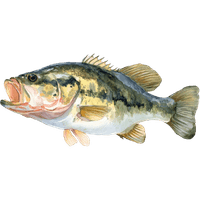
Inside the bass eye: two colour cones and no blue
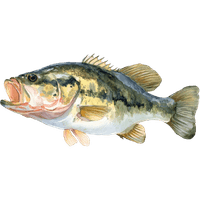
Every eye sees with two kinds of light-sensing cells. Rods work in dim light but cannot tell colours apart. Cones need brighter light and are what make colour vision possible. To see colour, an animal needs at least two types of cone, each tuned to a different part of the spectrum. Humans have three: blue, green and red.
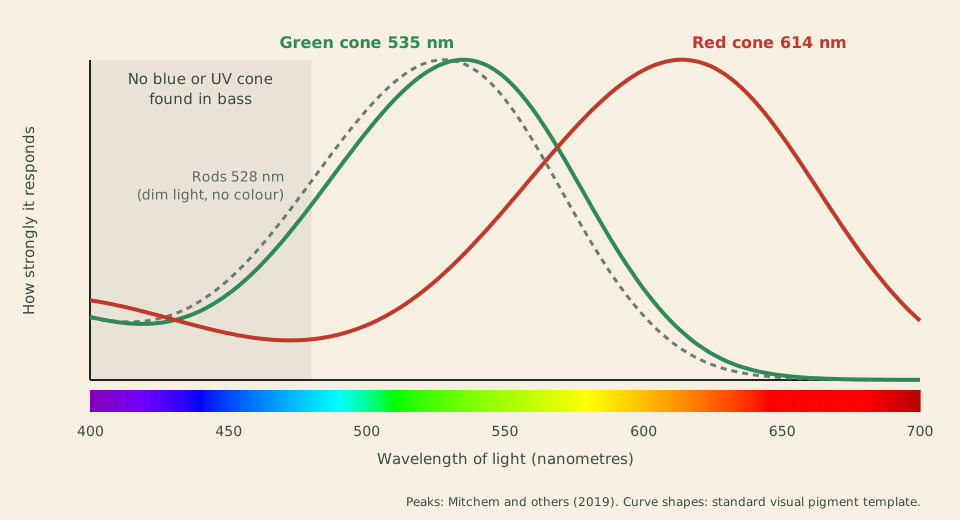
In 2018 a team led by the University of Illinois measured the cells in largemouth bass eyes one by one, using a microscope that measures which wavelength of light each cell absorbs best (Mitchem and others, 2019). They tested 246 cells from nine bass, including Florida and northern bass. They found:
535 nm green cone (single cones)
614 nm red cone (twin cones)
528 nm rods, for dim light
0 blue or UV cones found
So a bass has two colour cones, not three. Scientists call this dichromatic vision. It is a bit like a person with the rare blue-yellow type of colour blindness: green and red cones, but no working blue one. (Strong evidence: measured directly.)
The older evidence agrees
This is not one lucky result. Back in 1937, Frank Brown trained 31 largemouth bass to strike pipettes of one colour and ignore others. He found that bass told colours apart "in about the same manner" as a person with normal colour vision would through a yellowish filter (Brown, 1937). In 2002, Japanese researchers recorded the electrical signals in bass retinas and found direct proof of colour vision, with high sensitivity to red (Kawamura and Kishimoto, 2002).
How sharp is a bass's eyesight?
The same Japanese study worked out that a 43 cm bass has a visual acuity of about 0.10. On the same scale, normal human eyesight is 1.0, so a bass sees fine detail roughly ten times less sharply than you do. Its eye is built for spotting shape and movement, and the study found the closest point a bass can focus on is about 13.5 cm from its eye. (One study, calculated from the eye's structure.)
What this means on the water: a bass will not count the flakes in your worm. It sees an outline, a movement, and a colour that is either "like the background" or "stands out from it".
Keep reading for free
Create a free AnglersHub account or sign in to read the rest of this guide. It takes less than a minute and opens every free guide in the Academy.
You come straight back to this guide afterwards.
What bass actually see: the colour tests
Knowing which cones a bass has lets scientists predict which colours should look the same to it. A colour is only "different" to a bass if it excites its green and red cones in a different mix, or makes them fire more or less strongly overall (brightness).
The Illinois team tested those predictions on 100 young largemouth bass. Each group was trained to strike one of six colours, then offered that colour next to look-alikes of similar brightness (Mitchem and others, 2019).
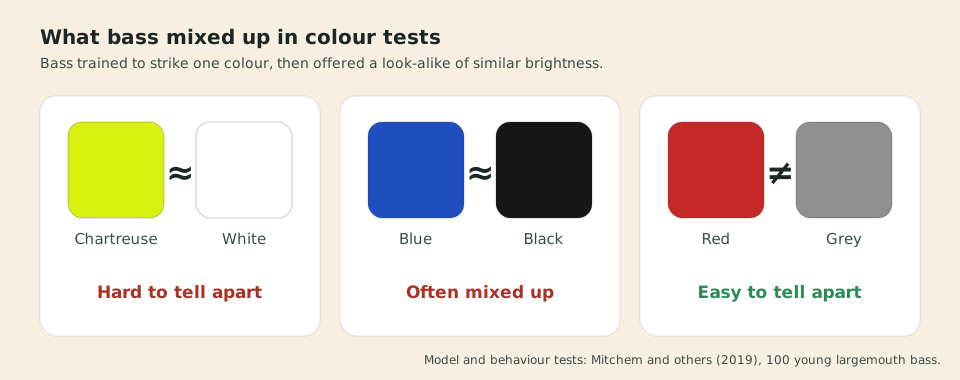
Easy for a bass
Red stood out from every grey, white and black tested. Green was also picked out reliably, and bass trained on red and green found their colour readily.
Hard for a bass
Chartreuse was hard to tell from white. It excites both bass cones about equally, which is how a bass eye sees "white".
Often mixed up
Blue was often confused with black. With no blue cone, a blue lure can read to a bass as just a dark shape.
One more finding matters for anglers: the bass relied on colour more than on brightness. Bass trained on red or green found their target readily. Bass trained on white, yellow or blue often struck the look-alike of similar brightness instead. (Strong evidence for these young bass in clear tank water; adult bass in the wild have not been tested this way.)
Myth: "Bass are colour blind."
Fact: Three independent studies over 80 years show bass see colour. They just see fewer colours than we do, and they see some of our colours as the same.
Myth: "Chartreuse is a special colour that bass can't resist."
Fact: To a bass, chartreuse looks a lot like white. It works because it is bright and stands out, not because it is magic. In many situations a white lure does the same job.
How water steals colour, metre by metre
Water is not see-through for every colour equally. Water molecules absorb red light strongly, orange less, and blue and green very little. That is why a swimming pool looks blue: the red has been soaked up on the way through.
Physicists have measured exactly how much each colour is absorbed by perfectly pure water (Pope and Fry, 1997). Using their numbers, here is how much sunlight of each colour is left as it goes straight down through perfectly clear water:
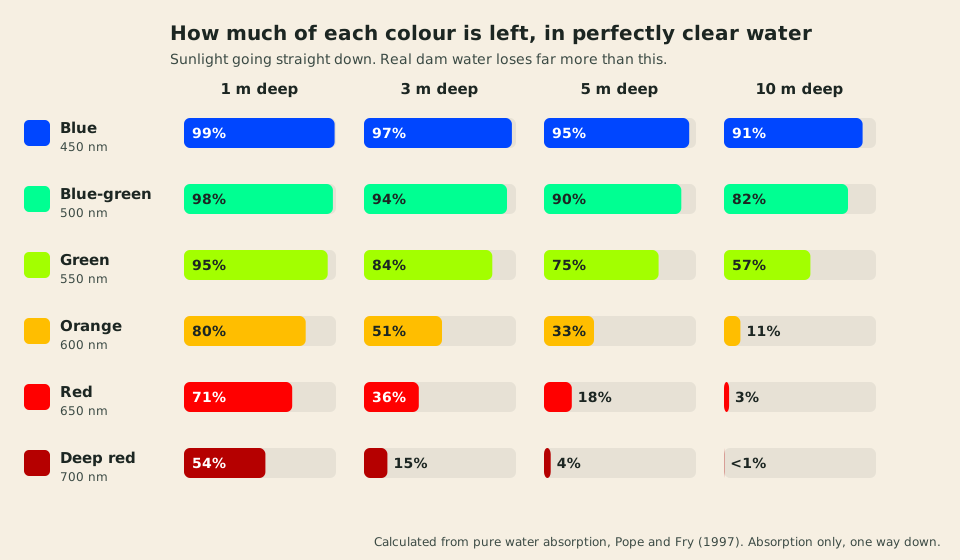
71% red light left at 1 m
36% left at 3 m
18% left at 5 m
3% left at 10 m
These are best-case numbers. They count only absorption by the water itself, for light going straight down. Real dam water also has mud, algae and dissolved plant stain in it, and light reflected off your lure still has to travel sideways to the bass. In a real dam every colour fades faster than this. (Strong evidence: laboratory physics.)
What happens to a red lure at depth
A lure has no light of its own. It can only reflect the colours that reach it. If little red light reaches 5 m, a red crankbait at 5 m has little red to reflect, so it looks dull brown, then dark, then black. The paint has not changed. The light has.
The same thing happens to orange, then yellow. Colours that survive deeper are the ones the water lets through.
Common mistake: choosing a deep-diving lure by how it looks in the shop. Under a bright shop light every colour pops. 5 m down in a dam, many of those colours look like shades of green, brown or grey.
The three waters of South African dams
The chart above is for perfectly clear water, like a clean mountain lake. South African dams are a different world. When researchers surveyed water clarity across South African impoundments, the most common average Secchi depth (how deep you can see a white disc) for 92 dams was between 0 and 0.5 m. Their conclusion: in most of our dams, fine suspended mud and silt is the main thing that controls how far light gets (Walmsley and Bruwer, 1980). (Strong evidence for SA, though the survey is old and many dams near cities have since turned greener with algae.)
What matters for colour is what is in the water, because each ingredient filters light differently.
Clear water
Secchi deeper than about 2 m. Blue and green carry furthest and red goes first, as in the chart above. Less common in SA, mostly in some deep, rocky dams and mountain waters.
Green or tea-stained water
Secchi about 0.5 to 2 m. Algae and dissolved plant stain soak up blue light. The light that is left is green in algae water and shifts to yellow, orange and red in tea-coloured water.
Muddy water
Secchi under 0.5 m. Silt scatters and blocks light of every colour within the first metre or so, and filters out the blue end first. Typical after rain, and the most common water in the SA survey above.
Why brown water turns the light red
In stained water the usual rule flips. Dissolved organic matter, the brown "tea" from rotting plants, soaks up blue light strongly. A 2025 study of 127 lakes found that as this stain increased, the colour of light that reached furthest shifted step by step from about 580 nm (yellow) to 650 nm (red) and close to 700 nm (deep red) (Ahonen and others, 2025). Mud and algae also filter out the blue end of the spectrum in inland waters (Enright and others, 2015).
So in many South African dams, blue goes first and red, orange and yellow last the longest, the opposite of the clear-water chart. (Strong evidence for the physics. How this plays out in a specific SA dam has not been measured, so treat it as a guide.)
The bass eye fits brown water
Look back at the bass eye: no blue cone, a green cone and a red cone peaking at 614 nm, right in the orange-red light that survives in stained water. That makes sense for a fish that evolved in the warm, weedy, often stained lakes and rivers of North America. It is our reading of the evidence, not a proven fact, but it explains why bass hunt so well in water that looks like coffee to us.
Some freshwater fish go further. They can switch their eyes to a second form of vitamin A (A2) that shifts their vision towards red and even near-infrared light, which helps in murky water (Enright and others, 2015). In the Illinois bass, most cells matched the normal form (A1), and the A2 form would only shift their cells by about 1.5 to 3 nm. Whether bass in muddy SA dams shift further has not been studied. (Unknown.)
Measure your water in 10 seconds: in the shade of the boat or a jetty, lower a white lure on your line until you just lose sight of it. That depth is a rough Secchi reading. Under 0.5 m is muddy, 0.5 to 2 m is stained, over 2 m is clear. A real Secchi disc is a 20 cm black and white plate, so your lure gives a rough answer, but it is enough to choose a colour.
When colour stops mattering: dawn, night and mud
Cones need light. As it gets dark, the bass eye hands over to its rods, which cannot see colour at all. At night a bass sees in shades of grey, like you do on a moonless walk. Colour is gone. What is left is brightness and outline. (Strong evidence: this is how all vertebrate eyes work.)
Bass are still very good hunters in low light. In tank tests, bass caught over 95% of the prey offered at every light level from dim daylight down to full moonlight. Success dropped to 62% at starlight, and close to zero in total darkness (McMahon and Holanov, 1995).
>95% catch rate, daylight to full moon
62% under starlight
~0% in total darkness
Murky water shrinks the hunting zone
The same researchers worked out what water clarity means for where bass can hunt by sight. In water with a 0.5 m Secchi reading, the depth with enough light to feed was 67 to 75% shallower than in water with a 2 m or 4 m Secchi reading (McMahon and Holanov, 1995). In muddy water, the zone where a bass can see your lure well is a thin layer near the surface and the shallows. (One study, a model built on tank results.)
Bass do not starve in muddy water, though. In feeding tests, bass caught just as many minnows at 1, 18 and 37 NTU (a unit of murkiness) as in clear water. Only at 70 NTU, which is very muddy, did they catch significantly fewer (Reid and others, 1999). For scale, another study measured a Secchi depth of about 11 cm at 57 NTU (Shoup and Lane, 2015).
That second study found that in the lab, bass ate less as water got muddier. But in three real reservoirs, with 714 bass checked, there was no sign that muddy-water bass ate less. They switched their diet instead, eating fewer crayfish and more fish as turbidity rose (Shoup and Lane, 2015). Bass also feel movement and vibration through the lateral line along their sides, which helps when eyesight fails.
What this means: in muddy water and at night, stop worrying about shade. Pick a lure the bass can find: a strong outline, a bold contrast against the water or sky, and vibration or noise it can feel.
Does lure colour really change your catch?
This is the question every angler wants answered, and the honest answer may surprise you.
Canadian researchers fished identical 12.7 cm soft-plastic worms in six colours (blue, black, red, a natural "wasp" pattern, white and orange) in a weedy Ontario lake, swapping colours in timed 20-minute rounds. They caught 119 largemouth bass. Catch rate was about the same for every colour (Moraga and others, 2015).
119 bass caught
6 colours, same worm
16 to 25 fish per colour, no real difference
349 mm average fish on bright colours, vs 318 mm on dark and natural
There was one interesting difference: the bright colours (white and orange) caught slightly bigger bass on average. The authors called it a possible small effect on size, not a proven rule. (One study, one lake in summer, one lure type.)
So does colour matter or not?
Both things are true. Bass clearly see colour, and colour changes how visible your lure is. But in a lake with fair visibility, a hungry bass will usually eat a well-presented worm whatever its colour. Colour matters most at the edges: when the water is muddy, deep or dark and the bass might not see your lure at all, or when the water is very clear and fish are wary and get a long look.
Myth: "The right colour is the secret to catching bass."
Fact: Location, depth, speed and lure size matter more. Colour is the last 10% of the puzzle. Get the other 90% right first.
The lure colour playbook for SA dams
These recommendations put the science above together with long-standing angler experience. No study has tested these exact colours in South African dams, so treat them as a smart starting point, then let the fish tell you. Check your water with the white-lure test first.
Clear water (Secchi over 2 m)
Bass get a long look, so go natural and translucent: green pumpkin, watermelon, brown and smoke in soft plastics, and silver, white or shad patterns in hard baits. Red and orange fade fast with depth here, so do not rely on them below about 3 m. Lighter line and subtle colours help with wary fish.
Green or stained water (Secchi 0.5 to 2 m)
Very common in our dams, especially the greener ones near cities. Go for contrast and warm colours: chartreuse or white (they do the same job to a bass), chartreuse with a dark back, and crab colours with orange or red tints, which survive well in stained water. On jigs and plastics, black and blue or a dark colour with a bright tail gives a clear outline.
Muddy water (Secchi under 0.5 m)
Think silhouette and vibration. Black, black and blue, or very dark colours give the boldest outline against the brighter water above. Solid white or chartreuse can also work close to the surface. Pick lures that thump: spinnerbaits with Colorado blades, chatterbaits, wide-wobble crankbaits and paddle tails. Fish slower and closer to cover.
Low light and night
Colour is gone, so use one dark colour. A black lure shows up best against the lighter sky when a bass looks up. Black buzzbaits, black jigs, dark paddle tails and noisy topwaters are classic night choices.
By depth
- Top 1 m: nearly every colour is still visible in clear and stained water. Match the bait, or go bright for attention.
- 1 to 3 m: red and orange are fading in clear water but holding up well in stained water. In clear water switch to natural greens, browns and whites.
- Deeper than 3 m: in most of our dams there is little colour left this deep. Contrast is everything: dark lures, or bright white and chartreuse that reflect whatever light is left.
Before you tie on
- Check the water clarity with the white-lure test.
- Decide the depth you will fish. The deeper and murkier, the more you need contrast instead of a natural colour.
- Look at the light. Bright sun and clear water means natural colours. Cloud, dawn, dusk or muddy water means bold, dark or bright.
- Match the size and shape of what bass eat, such as small kurper, baitfish and freshwater crabs.
- Give a colour a fair chance. If you are not getting bites, change depth or spot before you change colour.
Want to know when the water and light are right? Check water temperature, cloud and the bass Bite Score on the Weather Hub, read our Summer Bass science guide for where bass hold when it is hot, or start from scratch with Your First Bass. Your local tackle shop will know what colours are working on your dam this month.
Final thoughts
A bass sees the world through two colour cones, with no blue. It sees chartreuse much like white and blue much like black, and it sees red well, as long as there is red light to see. Water takes that light away fast: red first in clear water, blue first in the muddy and stained water most of our dams have. In the dark and in thick mud, colour disappears completely and outline and vibration take over.
So the next time you stand in front of that wall of forty colours, ask three questions: How clear is the water? How deep am I fishing? How much light is there? Answer those, and the colour almost picks itself.
Caught a bass on a colour that surprised you? Log it in the app so we can learn what works on South African dams.
The research behind this guide
We checked every number in this guide against these sources and wrote it in our own words. Most bass vision research was done in North America, so we applied it to South African dams using local water clarity data.
- Mitchem, L.D., Stanis, S., Zhou, M., Loew, E., Epifanio, J.M. and Fuller, R.C. (2019, online 2018). Seeing red: color vision in the largemouth bass. Current Zoology 65(1): 43 to 52. doi:10.1093/cz/zoy019. Cell counts and A1/A2 detail from L.D. Mitchem's 2017 MSc thesis, University of Illinois (read the thesis).
- Kawamura, G. and Kishimoto, T. (2002). Color vision, accommodation and visual acuity in the largemouth bass. Fisheries Science 68(5): 1041 to 1046. doi:10.1046/j.1444-2906.2002.00530.x.
- Brown, F.A. Jr. (1937). Responses of the large-mouth black bass to colors. Illinois Natural History Survey Bulletin 21: 33 to 55. doi:10.21900/j.inhs.v21.259.
- Pope, R.M. and Fry, E.S. (1997). Absorption spectrum (380 to 700 nm) of pure water. II. Integrating cavity measurements. Applied Optics 36: 8710 to 8723. Data via omlc.org.
- Walmsley, R.D. and Bruwer, C.A. (1980). Water transparency characteristics of South African impoundments. Journal of the Limnological Society of Southern Africa 6(2): 69 to 76. doi:10.1080/03779688.1980.9634548.
- Ahonen, S.A., Jones, R.I., Seppälä, J., Vuorio, K.M., Tiirola, M. and Vähätalo, A.V. (2025). Phytoplankton absorb mainly red light in lakes with high chromophoric dissolved organic matter. Limnology and Oceanography. doi:10.1002/lno.70034.
- Enright, J.M. and others (2015). Cyp27c1 red-shifts the spectral sensitivity of photoreceptors by converting vitamin A1 into A2. Current Biology. Summary from Washington University.
- McMahon, T.E. and Holanov, S.H. (1995). Foraging success of largemouth bass at different light intensities: implications for time and depth of feeding. Journal of Fish Biology 46(5): 759 to 767. doi:10.1006/jfbi.1995.0069.
- Reid, S.M., Fox, M.G. and Whillans, T.H. (1999). Influence of turbidity on piscivory in largemouth bass (Micropterus salmoides). Canadian Journal of Fisheries and Aquatic Sciences 56(8): 1362 to 1369. doi:10.1139/cjfas-56-8-1362.
- Shoup, D.E. and Lane, W.D. (2015). Effects of turbidity on prey selection and foraging return of adult largemouth bass in reservoirs. North American Journal of Fisheries Management 35(5): 913 to 924. doi:10.1080/02755947.2015.1067260.
- Moraga, A.D., Wilson, A.D.M. and Cooke, S.J. (2015). Does lure colour influence catch per unit effort, fish capture size and hooking injury in angled largemouth bass? Fisheries Research 172: 1 to 6. doi:10.1016/j.fishres.2015.06.010.
- Curve shapes in the bass eye chart use the standard visual pigment template of Govardovskii, V.I. and others (2000). In search of the visual pigment template. Visual Neuroscience 17: 509 to 528.