
Every bass comp ends the same way: a line at the scales, a bag of fish, a photo, and a release. Everyone wants those fish back in the dam, alive and ready for the next comp. But a bass that swims away from the weigh-in can still die days later, and nobody ever sees it.
That delayed death is what this guide is about. Scientists have been measuring tournament bass survival since the 1970s, and they know what kills fish in a livewell and what does not. Some of it will surprise you: more ice and more additives are not always better.
We mark how sure the science is as we go. Most of this research comes from bass tournaments in the United States and Canada. Our largemouth bass are the same species, but our water is often warmer and our Highveld dams sit high above sea level, which matters for oxygen. Where we apply the research to South African conditions, we say so.
In 30 seconds
- Oxygen is everything. Keep livewell water above 5 mg/L. Hot water and high altitude both mean less oxygen to start with.
- Fresh water when it is cool, closed loop when it is hot. Pump in dam water on cool days. On hot days, fill up, close the drains and recirculate.
- Cool a little, never a lot. Only 3 to 4 °C below the dam's surface temperature. Too much ice shocks fish.
- Additives are optional. Clean, well-oxygenated dam water beat commercial additives in a 2024 study.
- Fast weigh-in. Fish in a closed bag for no more than 2 minutes, and out of water for 10 to 20 seconds at the scales.
- Release in deep, open water, away from the weigh-in and away from the shore.
Why tournament bass die later
Scientists split tournament deaths into two kinds. Initial mortality is fish already dead at the weigh-in. Delayed mortality is fish that are released alive but die over the next few days from stress, injury and infection.
The biggest review pulled together results from 130 bass tournaments held between 1972 and 1996 (Wilde, 1998):
19.5% dead at the weigh-in in the 1970s
6.5% dead at the weigh-in in the 1990s
23.3% delayed deaths after release (1990s)
28.3% total deaths (1990s)
So the fish looked better at the scales by the 1990s, but about a quarter were still dying after release, and that had not improved since the mid-1980s. The study also found a strong link between water temperature and both kinds of death: the hotter the water, the more fish died. (Strong evidence: 130 tournaments.)
There is good news too. In B.A.S.S. tournaments, fish dead at the weigh-in fell from 15.2% in the 1970s to just 1.9% in the 1990s as fish care improved over those years (Wilde and others, 2002). The biggest predictor of dead fish at the scales was bag size: the more fish and the more weight in a livewell, the more died. Good fish care works, and crowding is the enemy.
Why this matters in South Africa: most of our big bass comps run through a long, hot summer, so everything in this guide matters most from November to March. Check the water temperature for your dam on the Weather Hub before comp day.
Keep reading for free
Create a free AnglersHub account or sign in to read the rest of this guide. It takes less than a minute and opens every free guide in the Academy.
You come straight back to this guide afterwards.
Oxygen: the number that matters most
A bass that has just been caught is out of breath. It has used up its energy stores and built up lactic acid, and it pays that debt back with oxygen. In a livewell it is sharing a small box of water with four or five other fish doing the same thing.
The B.A.S.S. guidebook Keeping Bass Alive (Gilliland, Schramm and Driscoll) sets the target: keep livewell water at 5 mg of oxygen per litre or more. That sounds easy until you look at how much oxygen water can hold at all:
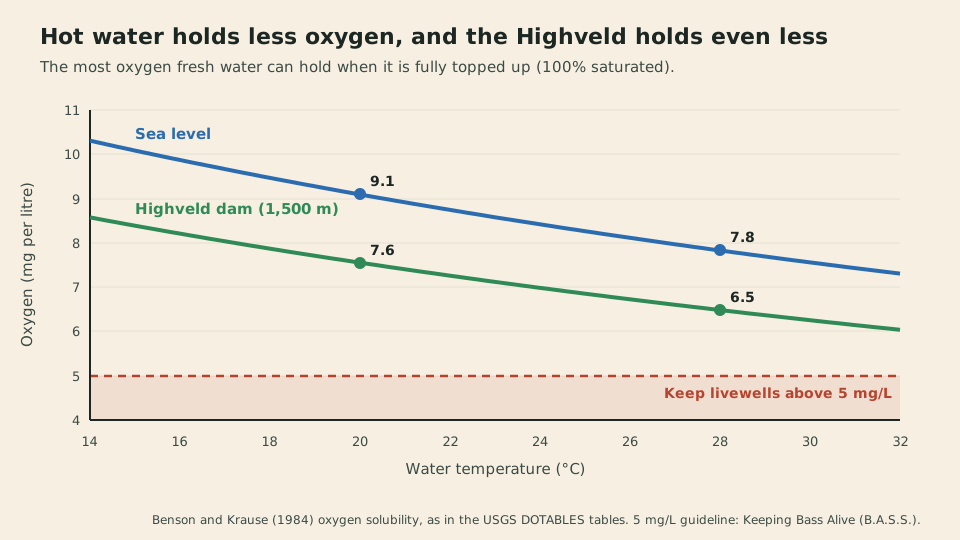
Two things work against you here:
- Heat. Warm water holds less oxygen, and warm fish use more of it because their bodies run faster.
- Altitude. Water holds oxygen in proportion to the air pressure above it. At about 1,500 m, where many Gauteng, Free State and Mpumalanga dams sit, air pressure is only about 83% of sea level, so fully aerated water holds about 17% less oxygen. A livewell setup that works at the coast can run short on the Vaal.
(Strong evidence: this is basic physics, from the standard oxygen tables used by the US Geological Survey. Applying the 5 mg/L target to SA dams is our reasoning.)
The guidebook also warns that aeration alone may not be enough for more than about 9 kg (20 lb) of bass in a livewell once the water is above 24 °C. That is easily reached by a good two-angler bag on a summer comp. In those conditions, boats need an oxygen system on top of the aerator.
More oxygen is not always better. A lab study found that bass recovering in water with too much oxygen (hyperoxia) recovered their energy stores more slowly, just as fish in low-oxygen water did (Suski and others, 2006). Pure oxygen in livewells helped in field tests when it was added slowly enough not to overload the water (Gilliland, 2002, reported in LaRochelle and others, 2024). Aim for normal, well-aerated water, not a bubbling jacuzzi of pure oxygen.
Temperature: cool a little, never a lot
If hot water is the problem, it is tempting to fill the livewell with ice. The research says go easy.
In the same lab study, Canadian researchers exhausted largemouth bass and let them recover for 2 hours at different temperatures (Suski and others, 2006). At 25 °C, most of the bass's body chemistry was back to normal within 4 hours. Recovery was slower at 32 °C, as you would expect, but it was also slower when the recovery water was much colder, at 20 °C and 14 °C. Cold water is not a cure, and a sudden drop in temperature is another shock. (Strong evidence: controlled lab study on largemouth bass.)
That is why the B.A.S.S. guidebook sets a small, careful target:
When to cool
Only when the morning surface water is above about 24 °C (75 °F) for largemouth bass.
How much
Cool the livewell 3 to 4 °C (5 to 7 °F) below the morning surface temperature, and no more.
How much ice
About 1 kg of ice per 30 litres of livewell water cools it for 2 to 3 hours. Test it on your own boat with a thermometer.
Too much ice
"Excessive ice results in temperature shock and increased mortality after fish are released." Released fish go straight back into hot water.
Our tip: freeze dam water in old 2 litre bottles instead of using loose ice. You control the cooling better, and you do not add chlorinated tap water to the livewell.
Does cooling actually save fish? The evidence is mixed. In 12 summer tournaments, livewells cooled by 2 to 5 °C, with salt and nonstop aeration, cut fish dead at the weigh-in from 7% to 3% (Schramm and others, 2006). But in Illinois tournaments, adding ice, salt or both did not change initial or delayed deaths; fish size and water temperature mattered more (Ostrand and others, 2011). (Mixed evidence.) Our reading: careful, gentle cooling probably helps in very hot water, but it will not rescue a crowded livewell that is low on oxygen.
Salt and additives
Many anglers add salt or a commercial livewell treatment. Here is what the research actually found:
- Salt. The B.A.S.S. guidebook suggests about 1 cup (250 ml) of non-iodised salt per 57 litres (15 gallons) of recirculating livewell water, to help fish balance the salts in their blood after stress. But it warns never to use salt with a livewell oxygen generator, because it can make chlorine.
- Commercial additives. A 2024 Canadian study tested three commercial livewell additives at the dose on the label. None of them improved how bass recovered, by blood tests or by how the fish behaved after release (LaRochelle and others, 2024).
- Chemical water conditioners even slowed recovery in one older study on bass (Cooke and others, 2002, reported in LaRochelle and others, 2024).
- Salt and ice together did not reduce deaths in Illinois tournaments, even above 30 °C (Ostrand and others, 2011).
The 2024 study's conclusion is the one to remember: use fresh, well-oxygenated dam water. Fish in every livewell were still stressed after 2 hours, so no product makes a livewell a safe place to be. (Good evidence that additives are optional; salt in a recirculating well is unlikely to hurt.)
Myth: "A good livewell treatment will keep fish alive in any conditions."
Fact: Oxygen, temperature and crowding decide whether fish live. Additives come a distant last.
The livewell routine, start to finish
This routine puts the guidebook's advice into the order you will use it on the day. Steps 1, 7 and 8 are good angler practice rather than tested rules.
Before you launch
Check the pumps, aerator and drain plugs. Make sure the livewell is clean, with no old fish slime or rotting weed. Pack a thermometer and frozen bottles of dam water if it will be hot.
Fill before your first fish
Fill the livewell with dam water from open, deeper water, not the muddy launch area. Do not wait until the first fish is flapping on the deck.
Check the surface temperature
Below about 24 °C: pump in fresh dam water regularly and run the recirculating pump all day. Above about 24 °C: fill the well, close the drains and recirculate full time, so you keep your cooler water instead of pulling in hot surface water. Cool 3 to 4 °C, no more.
Get each fish in fast
Unhook quickly with wet hands, keep air time short and put the fish straight in. Do not stop for a photo shoot every time. Cut the line on a deeply hooked fish.
Recirculate while you run
Keep the recirculating pump on whenever the boat is on the plane, and on the trailer if you drive to the weigh-in. Water sloshing in a sealed box with no aeration runs out of oxygen fast.
Keep the bag light
Use every livewell compartment to spread fish out. Cull as soon as you catch a bigger fish, and release the smaller one quickly and gently. Weight in the well is the biggest predictor of dead fish.
Check on your fish
Every hour or so, open the lid and look. Upright, breathing calmly fish are fine. A fish on its side, gasping at the surface or with flared, pale gills needs fresh, oxygenated water now.
Shade and lids
Keep the lid shut and the boat out of full sun when you can. A livewell in the sun on an aluminium hull heats up quickly.
The weigh-in
The weigh-in is where a lot of good livewell work is undone. Bass are crowded in a bag, lifted into the air and passed around under a hot sun. A Canadian study on largemouth bass found the weigh-in itself, especially the time in air, was a major added stress, and recommended that organisers cut air exposure at the scales as much as possible (Suski and others, 2004). (Good evidence.)
The B.A.S.S. guidebook sets clear limits:
7.5 L livewell water in each weigh-in bag, at least
2 min most time in a closed bag
10 to 20 s out of water at the scales
5 fish per bag at most, fewer if they average over 1.8 kg
- Do not bag your fish until you are close to the front of the line.
- Use a weigh-in bag that holds about 19 litres, with an outer waterproof bag and an inner mesh bag, as the guidebook recommends.
- Keep the bag in the shade and out of the hot sun on the walk to the scales.
- Hold big bass with two hands for the photo, one under the belly.
- Straight from the scales into a tank of fresh, aerated water.
Bass from deep water
A bass brought up quickly from deep water can arrive with an over-inflated swim bladder. It floats belly up and cannot stay down. The guidebook flags fish from deeper than about 6 m (20 ft) as at risk.
- Land deep fish slowly, so the gas has time to adjust.
- Venting ("fizzing") with a hollow needle through the side should only be done by someone trained. Use a thin 18-gauge needle about 4 cm long, about 1.5 to 2.5 cm behind the tip of the pectoral fin, with the fish underwater, and never squeeze the fish.
- Do not fizz through the mouth. A Texas Parks and Wildlife study found it caused more organ damage and lower survival, and it is no longer recommended.
- Weighted fin clips did not cure barotrauma or reduce deaths in studies.
Most South African bass are caught shallower than 6 m, so for most anglers the best advice is simple: if a fish comes from deep water, release it right away instead of keeping it for hours.
Releasing the fish
After all that care, do not undo it at the last step.
- Release fish in water that is less than about 6 m deep, so they do not get pressure problems, but deep enough to be cool and open.
- Release at least 800 m from the weigh-in and at least 90 m from the shore where possible, so fish spread out instead of piling up in one bay.
- Never release into a hot, still, shallow corner next to the launch.
- Release tanks should hold no more than 1 kg of bass per 8 litres of water, aerated and close to dam temperature.
- Release fish one at a time, gently, upright in the water.
For comp organisers
Organisers make the biggest difference of all. In hot months, the B.A.S.S. guidebook recommends:
- Shorter comps: no more than about 6 hours when the water is hot.
- Smaller bags: no more than 3 fish per angler in hot months.
- Aerated holding and release tanks, close to dam temperature and never overloaded, and a release site in open water away from the weigh-in.
- The weigh-in limits above: water in every bag, 2 minutes in a closed bag at most, 10 to 20 seconds in air.
Our extra suggestions, from common sense rather than studies:
- Staggered weigh-ins by flight, so no one waits long in the line with a bag of fish.
- Shade over the weigh-in line and the scales.
- Livewell checks before launch, and a rule that rewards live fish over dead ones.
Running a comp on AnglersHub? List it on the Competitions page and share this guide with your anglers before the day.
Your livewell checklist
- Thermometer, and know the dam's surface temperature at launch.
- Frozen 2 litre bottles of dam water on hot days.
- Working aerator and recirculating pump. An oxygen system for big summer bags.
- Non-iodised salt if you choose to use it (never with an oxygen generator).
- A weigh-in bag that drains, and a shady spot in the line.
- Wet hands, quick unhooking and a short photo.
Read How to Handle Fish for the basics of unhooking and holding bass, and check the water temperature on the Weather Hub before comp day.
Final thoughts
The fish at the weigh-in are the fish we all want to catch again next season. The research is clear about what keeps them alive: plenty of oxygen, gentle cooling only when it is hot, light bags, a fast weigh-in and a smart release. On a hot Highveld dam in December, every one of those counts.
Share this with your club and your comp WhatsApp group before the next event.
The research behind this guide
We checked every number in this guide against these sources and wrote it in our own words. US units from the B.A.S.S. guidebook have been converted to metric and rounded.
- Gilliland, G., Schramm, H. and Driscoll, T. Keeping Bass Alive: A Guidebook for Anglers and Tournament Organizers. B.A.S.S. PDF via Maryland DNR.
- Wilde, G.R. (1998). Tournament-associated mortality in black bass. Fisheries 23(10): 12 to 22.
- Wilde, G.R., Shavlik, C.E. and Pope, K.L. (2002). Initial mortality of black bass in B.A.S.S. fishing tournaments. North American Journal of Fisheries Management 22(3): 950 to 954. doi:10.1577/1548-8675(2002)022<0950:IMOBBI>2.0.CO;2.
- Suski, C.D., Killen, S.S., Kieffer, J.D. and Tufts, B.L. (2006). The influence of environmental temperature and oxygen concentration on the recovery of largemouth bass from exercise: implications for live-release angling tournaments. Journal of Fish Biology 68(1): 120 to 136. doi:10.1111/j.0022-1112.2006.00882.x.
- Suski, C.D., Killen, S.S., Cooke, S.J., Kieffer, J.D., Philipp, D.P. and Tufts, B.L. (2004). Physiological significance of the weigh-in during live-release angling tournaments for largemouth bass. Transactions of the American Fisheries Society 133: 1291 to 1303.
- Schramm, H.L., Walters, A.R., Grizzle, J.M., Beck, B.H., Hanson, L.A. and Rees, S.B. (2006). Effects of live-well conditions on mortality and largemouth bass virus prevalence in largemouth bass caught during summer tournaments. North American Journal of Fisheries Management 26(4): 812 to 825. doi:10.1577/M04-210.1.
- Ostrand, K.G., Siepker, M.J. and Wahl, D.H. (2011). Effectiveness of livewell additives on largemouth bass survival. Journal of Fish and Wildlife Management 2(1): 22 to 28. doi:10.3996/092010-JFWM-037.
- LaRochelle, L., Haniford, L., Burton, D., Bieber, J.F., Robichaud, J.A., Suski, C.D., Danylchuk, A.J. and Cooke, S.J. (2024). Do live-well additives influence the physiological and behavioral recovery of largemouth bass? North American Journal of Fisheries Management 44: 189 to 203. doi:10.1002/nafm.10975. Also the source for the Gilliland (2002) and Cooke and others (2002) findings.
- Schramm, H.L. and Gilliland, G. (2015). Achieving high survival of tournament-caught black bass: past efforts and future needs and opportunities. Journal of the Southeastern Association of Fish and Wildlife Agencies 2: 50 to 56.
- Benson, B.B. and Krause, D. (1984). The concentration and isotopic fractionation of oxygen dissolved in freshwater and seawater in equilibrium with the atmosphere. Limnology and Oceanography 29(3): 620 to 632. Oxygen values as used in the USGS DOTABLES tables.