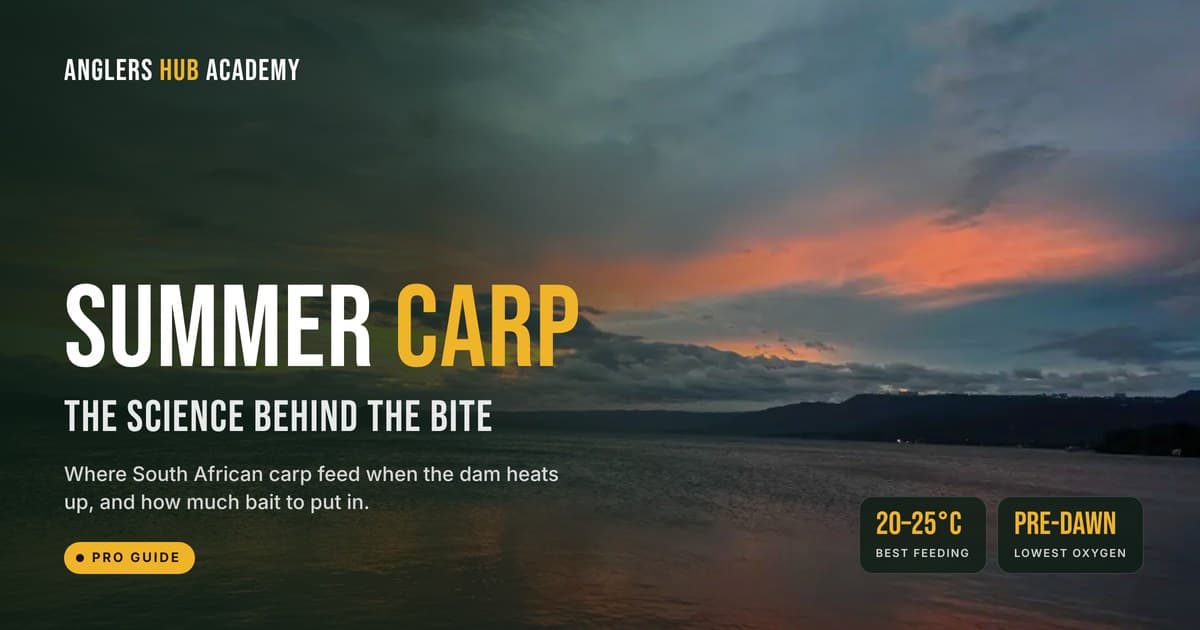
Summer is carp season in South Africa, and the numbers prove it. A year-long survey of more than 500 anglers at Gariep Dam (February 2007 to January 2008), our biggest reservoir, found that anglers caught about 0.88 kg of fish per hour in summer, against about 0.37 kg per hour in winter. That is more than double. Carp made up over 70% of everything caught (Ellender and others, 2010).
Yet every December the same story comes back from dams across the country. Someone sits through a hot day with a full bucket of mielies and a silent alarm, while an angler a few swims down lands fish after fish. The difference is rarely luck. Summer carp follow a few rules set by their bodies and by the water around them: heat, oxygen, light and food. Once you understand those rules, you stop fishing where carp were and start fishing where they have to be.
This guide explains the science behind summer carp behaviour in South Africa, from November to February. It covers what heat does to a fish with no stomach, the spring spawn, why the deep water in many of our dams is empty in summer, the daily oxygen cycle in green water, what tracking studies say about day and night movement, how carp find and choose food, how much bait to use, and how to look after carp in hot water. It focuses on common and mirror carp, with a short note on grass carp.
Facts in this guide are marked by how sure the science is. Where something is well proven, we say so. Where it rests on one study, or on angler experience, we say that too.
Sign in to keep reading
Create a free AnglersHub account or sign in to read more of this guide. The full guide is part of AnglersHub Pro.
You come straight back to this guide afterwards.
Carp in South Africa: a quick background
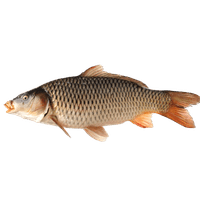
Common carp (Cyprinus carpio) come from Europe and Asia. They were brought to South Africa long ago and stocked so widely that today they live in almost every major dam in the country, from the Vaal and Hartbeespoort to Gariep and the farm dams of the Free State.
- They are a listed alien species. Carp are regulated under South Africa's alien and invasive species laws. Moving live carp to another water is illegal, and you need a provincial angling licence in most provinces.
- They grow fast and live long. A Rhodes University study of carp in Groenvlei, a lake near Sedgefield, found carp grow quickly for their first three to five years, mature at two to three years old, and can live for up to 20 years. Elsewhere in the world, carp have been recorded at over 30 years old (Murray-Darling Basin fish fact sheet).
- They breed in huge numbers. A single 6 kg female can carry about 1.5 million eggs (Murray-Darling Basin fish fact sheet). That is why carp dominate so many of our dams, and why there is always a new generation of fish to catch.
- They are the backbone of SA angling. From weekend bank anglers to club competitions and the subsistence anglers who feed families at Gariep, carp are the fish most South African freshwater anglers catch most often.
Read more about the species on our carp page.
Keep reading with AnglersHub Pro
The other 21 sections of this guide are for Pro members. Pro also unlocks Billy the Bot, Fish ID, the live weather map and your personal bite windows.