The knot is the weakest point between you and the fish. Most lost fish are not bad luck: they are a knot that slipped, a knot that was not wet before it was pulled tight, or the wrong knot for the line. The good news is that you only need a handful.
These six knots cover almost every rig you will fish on South African dams, from a bass lure to a carp hair rig to a braid main line with a fluorocarbon leader. Learn the palomar first. Add the others as you need them.
In 30 seconds
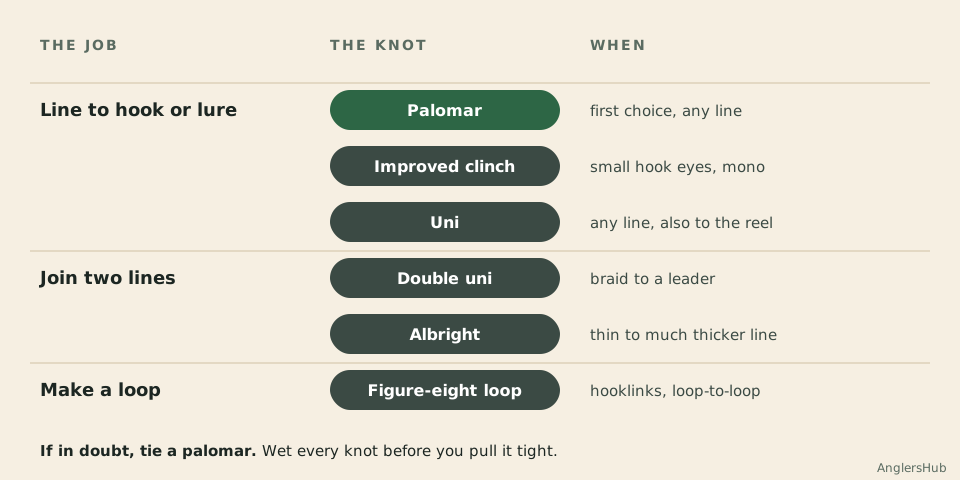
- Palomar: line to hook or lure. Strong, simple, the one to learn first.
- Improved clinch: line to hook or swivel, when the eye is too small for a palomar loop.
- Uni: the all-rounder. Line to hook, and line to reel spool.
- Double uni: join two lines, such as braid to a mono or fluoro leader.
- Albright: join lines of very different thickness.
- Figure-eight loop: a strong fixed loop at the end of a line or hooklink.
- Always wet the knot before you pull it tight, then test it with a firm pull.
Which knot for which job
Five rules for every knot
Wet it
Lick or dip the knot before pulling it tight. Friction heat weakens mono and fluorocarbon.
Pull slowly
Tighten with a steady pull, not a snap, so the turns seat neatly.
Neat turns
Turns that cross over each other cut into the line under load.
Test it
Give every knot a firm pull before you cast. Better to break it in your hands than on a fish.
Trim, don't burn
Leave a 2 to 3 mm tag and trim it with clippers. Burning the tag can melt the knot.
Knot strength: no knot is as strong as unknotted line. In Field and Stream's tests, a well-tied palomar kept about 89% of mono's strength, and an improved clinch tied with great care kept up to 96%, but only 75% on fluorocarbon (Merwin). How well you tie it matters more than which knot you choose.
Keep reading for free
Create a free AnglersHub account or sign in to read the rest of this guide. It takes less than a minute and opens every free guide in the Academy.
You come straight back to this guide afterwards.
1. Palomar knot
Full guide: How to Tie the Palomar Knot, with a picture for every step.
About 89% strength kept on mono
Easy to tie
Hooks, lures, swivels best for
Mono, fluoro, braid line types
Video coming soon
The palomar is the first knot to learn. It is strong, quick, hard to tie badly and works on braid, where many knots slip. The only catch: you pass a loop through the eye, so it is awkward with big lures and tiny hook eyes.
Double the line
Fold about 15 cm of line back on itself to make a loop.
Through the eye
Push the loop through the eye of the hook or lure.
Tie an overhand knot
Tie a loose overhand knot with the doubled line, with the hook hanging from the bottom.
Loop over the hook
Pass the end of the loop over the whole hook or lure.
Wet and tighten
Wet the knot and pull both the main line and the tag end so the knot slides up to the eye.
Trim
Trim the tag end, leaving about 2 to 3 mm.
Common mistake: twisting the loop when you pass it over the lure. Keep the two strands side by side, or the knot bunches and weakens.
2. Improved clinch knot
Up to 96% on mono, tied carefully
Easy to tie
Small hooks, swivels best for
Mono and fluoro (not braid)
Video coming soon
The classic hook knot. It only needs a single strand through the eye, so it is ideal for small kurper hooks and swivels. It is not a good choice for braid, which can slip.
Through the eye
Pass about 15 cm of line through the eye of the hook.
Twist
Wrap the tag end around the main line 5 to 7 times. Use fewer turns on thick line.
Into the first loop
Pass the tag end back through the small loop just above the eye.
Back through the big loop
Now pass the tag through the big loop you just made. This is the "improved" step.
Wet and tighten
Wet the knot and pull the main line slowly so the turns coil down neatly against the eye.
Trim
Trim the tag end.
Common mistake: pulling the tag end instead of the main line. The turns should slide down neatly; if they pile up on top of each other, cut it and tie it again.
3. Uni knot
High strength when tied neatly
Easy to tie
Hooks, swivels, reel spool best for
Mono, fluoro, braid line types
Video coming soon
The uni is the Swiss army knife of knots. Tie it to a hook, a swivel or the spool of your reel, and two unis make the double uni for joining lines. Use more turns on braid.
Through the eye
Pass about 20 cm of line through the eye and lay the tag back alongside the main line.
Make a loop
Bend the tag end back towards the hook to form a loop lying over both strands.
Wrap inside the loop
Wrap the tag end around both strands and through the loop 5 to 6 times (8 to 10 on braid).
Snug it
Wet it and pull the tag end to close the turns into a neat barrel.
Slide it down
Pull the main line so the knot slides down to the eye.
Trim
Trim the tag end.
Loop option: stop the knot before it reaches the eye and you have a loop that lets a lure swing freely. It closes on the first fish.
4. Double uni knot
Full guide: How to Tie the Double Uni Knot, with a picture for every step.
Good strength, very reliable
Medium difficulty
Joining two lines best for
Braid to mono or fluoro
Video coming soon
Use the double uni to join braid to a fluorocarbon or mono leader, or to repair a line. It is easier to learn than the FG knot many experts use, and plenty strong for dam fishing.
Overlap the lines
Lay the two ends side by side, overlapping by about 20 cm.
First uni
With the end of line A, tie a uni knot around line B. Use 8 to 10 turns if line A is braid, 5 to 6 if it is mono.
Second uni
With the end of line B, tie a uni knot around line A in the other direction.
Snug each knot
Wet both knots and pull each tag end so each knot tightens on its own.
Pull them together
Pull the two main lines apart slowly so the knots slide together and lock.
Trim
Trim both tags close.
Common mistake: too few turns with braid. Braid is slippery, so give it double the turns you would use with mono.
5. Albright knot
Full guide: How to Tie the Albright Knot, with a picture for every step.
Very secure with lines of different thickness
Medium difficulty
Leaders, heavy traces best for
Thin to thick line
Video coming soon
The Albright joins two lines of very different thickness, such as thin braid to a heavy mono leader for barbel, or line to a wire trace. Field and Stream calls it an extremely secure connection for lines of different diameters (Merwin). It is also slim, so it passes through rod guides well.
Loop the thick line
Fold the end of the thicker line back to make a loop about 5 cm long.
Thin line in
Pass about 25 cm of the thinner line through the loop from below.
Wrap forwards
Pinch everything together and wrap the thin line around all three strands 10 to 12 times, working towards the end of the loop.
Back out
Pass the thin tag end back out through the loop on the same side it went in.
Slide and tighten
Wet the knot, then pull gently on both ends of the thin line to slide the wraps towards the end of the loop without letting them fall off. Then pull all four ends tight.
Trim
Trim both tag ends.
Common mistake: letting the wraps slide off the end of the loop while tightening. Hold them with your thumbnail as you pull.
6. Figure-eight loop
Fixed loop that never slips
Easy to tie
Loop-to-loop, hair rigs, droppers best for
Mono, fluoro, braided hooklinks
Video coming soon
The figure-eight loop makes a strong, fixed loop at the end of a line. Carp anglers use it for loop-to-loop connections on hooklinks and for a quick-change swivel. It is bulkier than other knots, but it is easy to check by eye and it does not slip.
Double the line
Fold about 15 cm of line back on itself.
Make a loop
Form a loop with the doubled line, crossing the end over the standing part.
Go around
Pass the end of the doubled line around behind the standing part.
Back through
Push it down through the first loop. You should see a clear figure eight.
Size the loop
Adjust the size of the loop before you tighten.
Wet and tighten
Wet it, then pull the loop and both strands firmly in opposite directions. Trim the tag.
Common mistake: a lopsided figure eight. If the two halves do not mirror each other, untie it and try again before you tighten.
Practise at home
Tie each knot ten times on the couch with a hook and some old line before you need it on the bank. Use thick line or string to learn the shape, then thin line once you have it. Tie it in the dark once you are confident: you will be doing it at dawn with cold hands.
Next up: put your palomar to work with our guide to catching your first bass, or check what to buy for your first kit.
Sources
- Merwin, J. Tie the strongest fishing knots (knot strength tests). Field and Stream, republished by Popular Science (2021). Article.