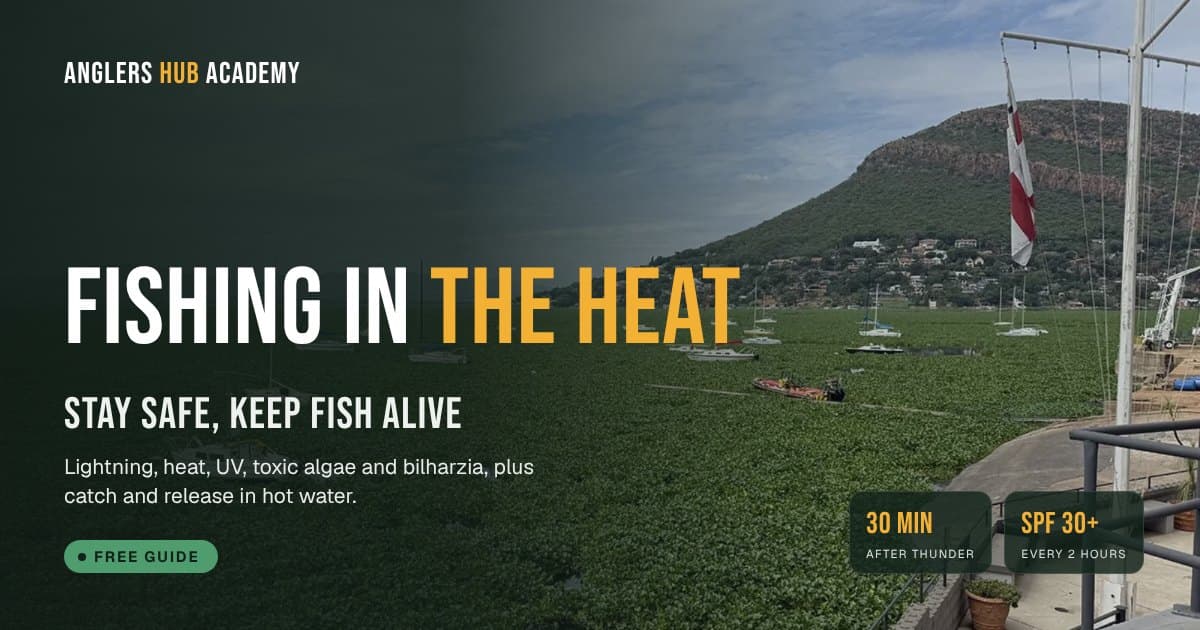
Summer is the best fishing season of the year in most of South Africa, and also the most dangerous. Afternoon thunderstorms build in minutes. Midday sun on open water is fierce. Some of our best-known dams grow toxic algae. And the fish we put back are under more stress in hot water than at any other time of year.
None of this should keep you at home. This guide is a practical checklist for staying safe on the water from November to March, and for making sure the fish you release actually live.
In 30 seconds
- If you hear thunder, get off the water and into a car or building. Wait 30 minutes after the last rumble.
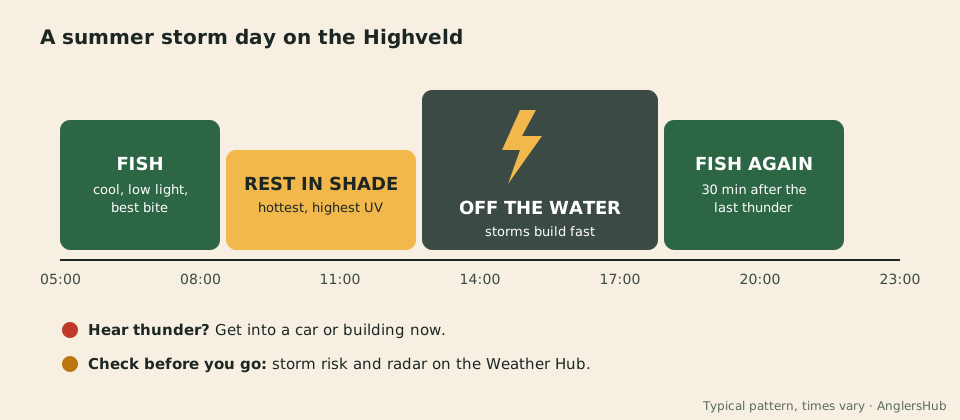
- Fish early, rest at midday, and plan to be off the water by mid-afternoon on storm days.
- Drink before you are thirsty, cover up, and know the signs of heat stroke.
- Keep dogs away from green scum and don't wade in warm, weedy water in bilharzia areas.
- Land fish fast, keep them wet, release them quickly in good water.
This guide gives general safety information, not medical advice. In an emergency call 112 from a cellphone or 10177 for an ambulance.
Lightning: the biggest danger on the water
South Africa has one of the highest lightning death rates in the world, roughly four times the global average (Gijben, 2012). The summer rainfall region, which covers most of the country's inland dams, often gets more than 60 thunderstorm days a year, mostly from fast-building afternoon storms between October and March.
An angler on open water or an open bank, holding a long carbon rod, is one of the most exposed people around.
The rules
- When thunder roars, go indoors. If you can hear thunder you are close enough to be struck. Lightning can hit more than 10 km from the rain.
- Safe shelter is a solid building or a car with a metal roof and the windows shut. A gazebo, umbrella, tent or tree is not safe.
- Wait 30 minutes after the last thunder before going back out.
- Put the rod down. Carbon rods conduct electricity. Never cast or hold a rod with a storm close by.
- Get off the water early. On a boat, head for shore when you see a storm building, not when it arrives.
- Stay away from lone trees, high ground, fences and the water's edge.
- Spread out. If a group is caught in the open, stand well apart.
Plan around the storms
On the Highveld most summer storms build in the afternoon. Fish early, and plan to be off the water by mid-afternoon on storm days. Check the storm risk on the Weather Hub before you go and watch the radar during the day. The AnglersHub Bite Score drops sharply when storm danger is high, and that is the one part of the score you should always obey.
If someone is struck: it is safe to touch them, they carry no charge. Call 112 or 10177, start CPR if they are not breathing and you know how, and move to safety if the storm is still close.
Keep reading for free
Create a free AnglersHub account or sign in to read the rest of this guide. It takes less than a minute and opens every free guide in the Academy.
You come straight back to this guide afterwards.
Heat: know the warning signs
A summer day on an open bank can be well over 30 °C, with no shade and sun bouncing off the water. Heat illness creeps up slowly, especially when you are focused on a float.
Heat exhaustion
- Heavy sweating, weakness, tiredness.
- Headache, dizziness, feeling faint.
- Nausea or cramps.
- Pale, cool, clammy skin.
- Do: shade, lie down, loosen clothes, sip cool water, wet cloths on the skin. Get help if not better in 30 minutes.
Heat stroke: an emergency
- Confusion, slurred speech, odd behaviour.
- Hot skin, dry or still sweating.
- Very high body temperature.
- Fainting, fits or collapse.
- Do: call 112 or 10177 now. Cool them fast: shade, soak skin and clothes, fan, cold packs on neck, armpits and groin. No drinks if confused.
Staying cool
- Drink before you are thirsty, and carry more water than you think you need. Take extra for kids and dogs.
- Go easy on alcohol on hot days. It speeds up dehydration.
- Use shade: an umbrella or gazebo (not in a storm), and fish the shady bank in the heat of the day.
- Take the midday break. Fish are hard to catch between about 11:00 and 15:00 in midsummer anyway. Rest then.
- Never leave kids or dogs in a parked car, even for a few minutes.
Sun: South Africa's UV is extreme
In summer the UV index in most of South Africa regularly reaches the very high to extreme range by late morning. Water and pale sand reflect UV back at you, so you burn faster on the water than in your garden.
- Cover up: a wide-brim hat, a long-sleeve UPF fishing shirt and a buff for neck and face.
- Sunscreen: SPF 30 or higher on all bare skin, again every two hours and after getting wet.
- Polarised sunglasses protect your eyes and let you see fish and structure in the water.
- Lips and ears burn easily. Use a lip balm with SPF.
Toxic algae: when to stay away
Some South African dams, Hartbeespoort the best known, grow huge blooms of blue-green algae (cyanobacteria) in summer. Some blooms produce toxins that harm people, dogs and livestock. A risk study at Hartbeespoort found toxic cyanobacteria and their toxins in the dam (University of the Witwatersrand), and blooms there have caused skin rashes in people and made dogs ill (Live Science).
How to spot a bloom
- Water that looks like green paint or pea soup.
- Scum or a thick green layer on the surface, often blown into bays and against the bank.
- A bad smell, especially where scum is rotting.
What to do
- Keep dogs out of the water and stop them drinking it or licking scum off their fur. Dogs are at the highest risk.
- Don't wade or swim in water with visible scum.
- Wash your hands with clean water before you eat, and rinse skin that touched the water.
- Think twice before eating fish from a dam with a bad bloom. Don't eat the liver or guts, and remember that cooking does not destroy these toxins.
- Fish another dam, or the upwind side where the water is clearer.
Big blooms also use up oxygen and can kill fish. If you see dead fish along the bank, fish somewhere else that day.
Bilharzia
Bilharzia (schistosomiasis) is a parasite carried by small freshwater snails in warm, slow or still water. In South Africa it is endemic in Limpopo, Mpumalanga and KwaZulu-Natal, with transmission also in parts of North West, Gauteng and the Eastern Cape (De Boni and others, 2021). The parasite enters through the skin when you stand or wade in infected water.
- Avoid long wading in warm, shallow, weedy water in these areas. Waders help.
- Towel dry quickly after contact with the water.
- It is treatable. If you later notice blood in your urine, stomach pain or an itchy rash, tell a doctor where you fished.
Wildlife: crocodiles, hippos and snakes
Some dams and rivers in Limpopo, Mpumalanga, North West and KwaZulu-Natal have crocodiles, and some have hippos. Ask the venue before you fish new water in these areas.
- Stay back from the edge in crocodile areas, and never stand in the water to land a fish.
- Don't clean fish at the edge, and don't fish the same spot on the edge at the same time every day.
- Keep well away from hippos, especially between the water and the grass where they feed at night.
- Snakes are active in summer. Wear closed shoes, watch where you put hands and feet in grass and rocks, and use a torch at night. Puff adders lie still and are easy to step on.
On the water: boats and kayaks
- Wear a life jacket, and make sure every person on board has one that fits.
- Check the wind before you launch. Big dams like the Vaal get rough fast when a storm wind arrives.
- Tell someone your plan: where you are launching and when you will be back. The free NSRI SafeTRX app logs your trip and alerts your contacts if you are overdue.
- Carry a charged phone in a waterproof bag, with 112 saved.
- Never swim after a snagged lure or a dropped rod.
Night fishing safety
Summer nights are prime time for carp and barbel. A few habits keep them safe.
- Fish with a friend where you can, and tell someone where you are.
- Set up before dark so you know where the edge, rocks and drop-offs are.
- Use a headlamp and keep a spare torch.
- Keep valuables out of sight and lock the car.
- Check that night fishing is allowed at the venue.
Keeping fish alive in hot water
Hot water holds less oxygen while the fish needs more of it. A fish that has fought hard in 28 °C water is short of oxygen and full of waste from the effort. How you handle it in the next few minutes decides whether it lives.
7.4 mg/L oxygen in water at 32 °C
11.9 mg/L oxygen in water at 7 °C
98% vs 55% survival, mouth-hooked vs deep-hooked bass
Oxygen figures are for fully saturated water (University of Florida IFAS). The survival figures come from a model built on many bass release studies (Wilde and Pope). Delayed deaths after summer bass tournaments have been estimated at up to 40% in the worst conditions, mostly from long livewell times in hot water (Maryland DNR).
Ten rules for summer catch and release
Use strong enough tackle
Land fish quickly. A long fight on light line in hot water exhausts a fish.
Strike early
On soft plastics and baits, and use circle or wide-gape hooks to avoid deep hooking.
Cut, don't tear
Cut the line on a deep-hooked fish rather than ripping the hook out.
Wet your hands
And use a wet unhooking mat for carp and barbel.
Keep it in the water
Unhook in the water where you can, and keep air time to a quick photo.
Support big fish
Hold them horizontally under the belly. Never hang a heavy fish by its jaw.
Skip sacks and keep nets
Warm, shallow margins run low on oxygen quickly in hot weather.
Look after livewells
Keep them aerated, swap in fresh water often and keep the boat out of full sun.
Release in good water
Deeper, with some wind or flow, not a hot, still, shallow corner.
Hold it upright
Keep the fish upright in the water until it swims off strongly on its own.
Your summer fishing checklist
- Plenty of drinking water, plus extra for kids and dogs
- Hat, long-sleeve shirt, buff and polarised sunglasses
- Sunscreen (SPF 30 or more) and lip balm
- Shade: umbrella or gazebo
- Charged phone in a waterproof bag, with 112 and 10177 saved
- First aid kit
- Life jackets for everyone on a boat or kayak
- Headlamp and spare torch for night sessions
- Wet unhooking mat, long-nosed pliers and line cutters
- Towel for drying off after contact with the water
- Storm check on the Weather Hub before you leave
Final thoughts
Summer fishing in South Africa is worth every early start. Fish early, get off the water before the storms, cover up, drink water, and treat every fish like you want to catch it again. Do that and summer will give you the best fishing of the year.
Check the storm risk for your dam on the Weather Hub, and read our summer Pro guides to bass, carp, barbel and kurper in the Academy.
Sources
- Gijben, M. (2012). The lightning climatology of South Africa. South African Journal of Science 108(3/4). Read the paper.
- De Boni, L., Msimang, V., De Voux, A. and Frean, J. (2021). Trends in the prevalence of microscopically-confirmed schistosomiasis in the South African public health sector, 2011 to 2018. PLoS Neglected Tropical Diseases 15(9). Read the paper.
- University of Florida IFAS Extension. Dissolved oxygen for fish production (FA002). Factsheet.
- Wilde, G.R. and Pope, K.L. A simple model for predicting survival of angler-caught and released largemouth bass. USGS record.
- Maryland DNR on delayed summer tournament mortality, via Woods and Waters Magazine.
- University of the Witwatersrand. A risk assessment of cyanobacteria and cyanotoxins in Hartbeespoort Dam. Record.
- Live Science. Vivid green mass sprawls across a South African reservoir. Article.
- Kormorant. NSRI urges caution for boaters on Hartbeespoort Dam (SafeTRX app). Article.