
Most first bass are lost to two habits: fishing too fast and setting the hook too softly. Fix those two and you will catch fish on almost any dam, with the kit and rigs you already have.
This part covers the cast, the retrieve for each rig, what a bite looks like, the hook set, and landing and releasing your fish. If the bites dry up, there is a checklist at the end.
In 30 seconds
- Cast with the line on your index finger, let go at 10 o'clock, and feather the line so the bait lands softly next to cover.
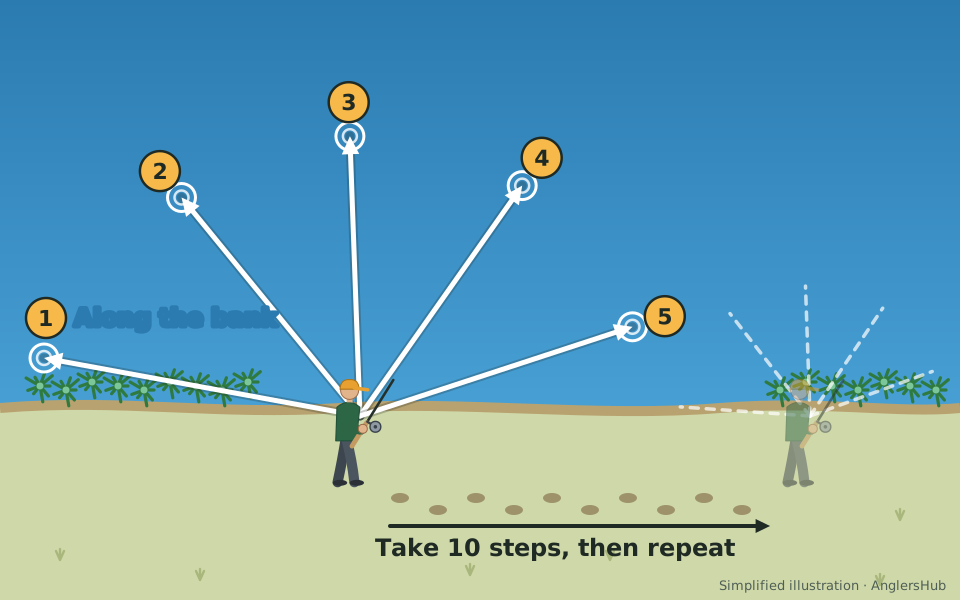
- Fan 5 casts from each spot, then take 10 steps and do it again.
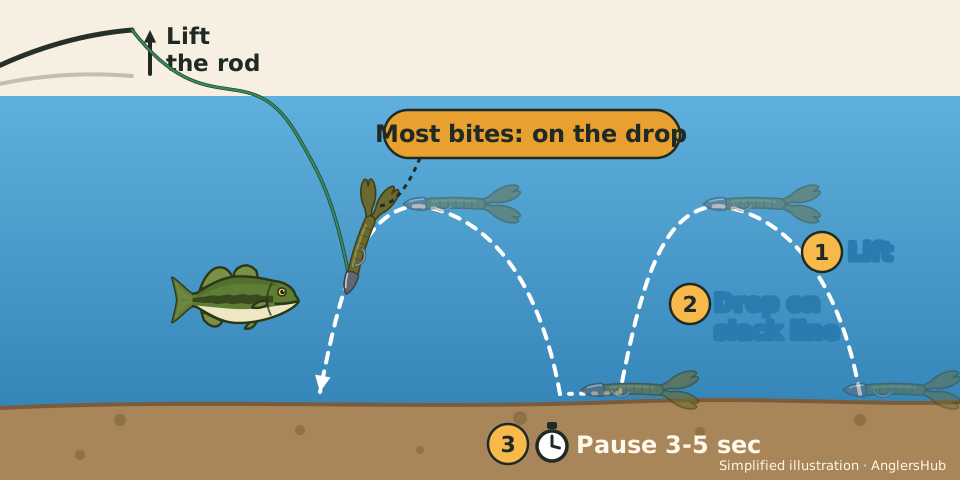
- Fish slowly. Let it sink, pause 3 to 5 seconds, and watch your line. Most bites come as the bait falls.
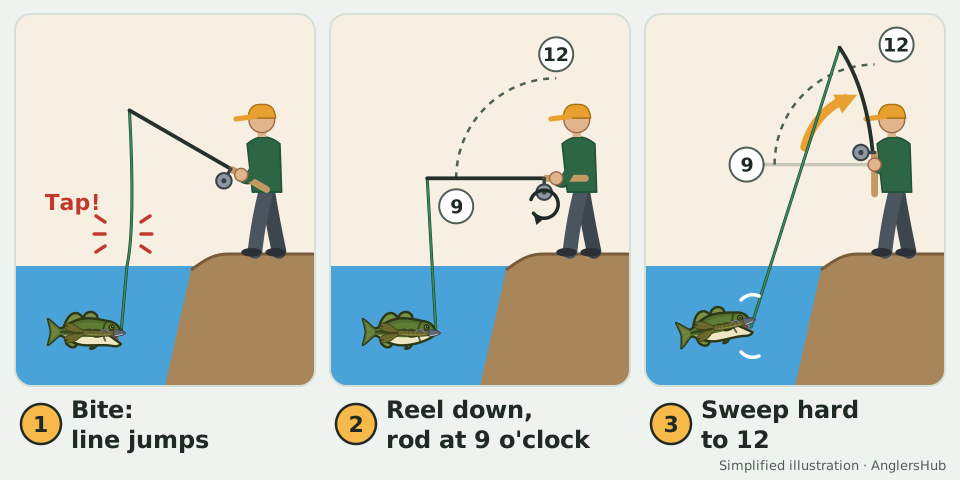
- Bite? Point the rod at the line, reel until it is tight, then sweep the rod up hard.
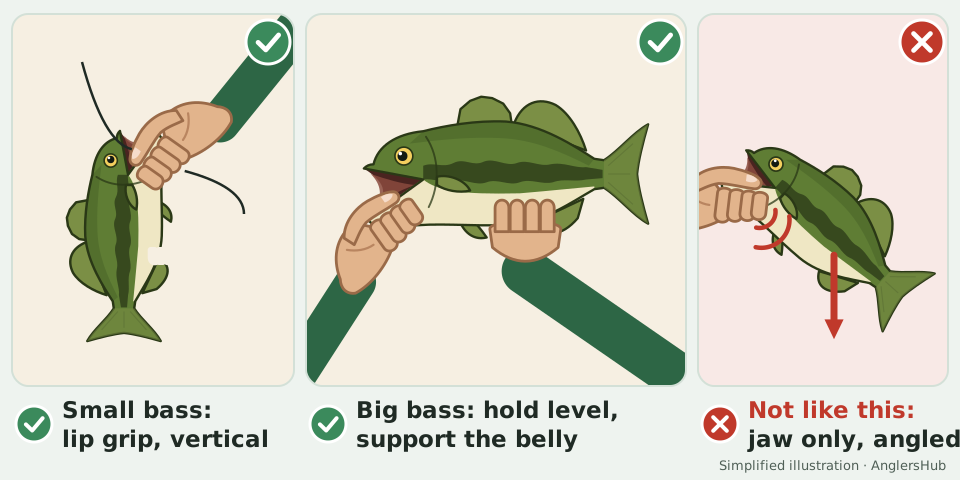
- Keep the rod bent, let the drag work, lip the fish, support big ones, and get it back in the water fast.
10 o'clock let go of the line here
3 to 5 sec pause on the bottom
5 or 6 casts per piece of cover
15 to 20 min no bites? Move
Cast and cover the water
A spinning reel is the easiest reel to cast. Before your first trip, tie a 7 g (1/4 oz) sinker on with no hook and practise hitting a bucket 10 to 15 m away on the lawn.
Clock positions here are seen from the side, water to the left: 12 o'clock is the rod straight up, 9 o'clock is the rod flat, pointing at the water.
Hang the bait
Reel up until the bait hangs 20 to 30 cm below the rod tip. Hold the rod with the reel stem between your middle and ring fingers.
Line on your finger
Turn the handle until the line roller sits near your index finger. Hook the line with that finger and hold it against the rod handle.
Open the bail
Flip the bail arm open with your other hand. Only your finger holds the line now.
Back to 1 o'clock
Face the target and lift the rod smoothly to just past straight up.
Flick, let go at 10
Flick the rod forward and straighten your finger as it passes 10 o'clock. Follow through until the rod points at the target.
Feather, stop, close
As the bait nears the target, lower your finger so the line brushes it, or touch the spool lip, to slow it for a soft landing. Press to stop it, then flip the bail closed by hand.
Tip: bait flying straight up? You let go too early. Slapping into the water in front of you? Too late. Closing the bail by hand, not by cranking, also means fewer loops and tangles.
Accuracy beats distance. A bass on a reed edge sees a bait that lands 30 cm from the reeds, not one 3 m out. Cast past your target and bring the bait back along it.
From each spot, cast in a fan. The first cast goes parallel to the bank, right along the reeds, because bass often sit tight to the edge. Fan each cast further out, then walk about 10 steps and repeat. Fish the close water first, standing back from the edge, before you spook it.
Level up: skip it under overhanging trees and jetties, where bass sit in the shade. Make a low, hard sidearm cast so the bait first hits the water just in front of the cover and skips across the surface like a flat stone. A weightless wacky stick bait skips best.
Unlock Part 5 for free
Create a free AnglersHub account or sign in to read the rest of this part and every other part of the course. Your progress is saved to your account, so you can pick up on any device.
You come straight back to this guide afterwards.
Fish it slowly
Bass are ambush hunters. A bait that sinks slowly, sits still and then twitches looks like easy food. A bait pulled past at walking pace mostly gets ignored, especially in cool water.
Most bites come as the bait sinks. Let it fall on a slightly slack line and watch where the line enters the water. Polarised glasses make this far easier.
Texas rig: lift and drop
Let it sink until the line goes limp: it is on the bottom. Lift the rod slowly from 9 to 11 o'clock so the craw hops up, then drop it back to 9, reeling only the slack as it falls. Pause 3 to 5 seconds. Repeat.
Wacky rig: fall and twitch
Cast to the edge of cover and let it sink all the way, no reeling. On the bottom, give 2 or 3 short twitches on a slack line, let it fall again and count to five. Once it is 2 to 3 m from the cover, reel in and recast.
Mojo rig: slow drag
Lob it out gently (a hard cast tangles the rig) and let the sinker hit bottom. Rod low, sweep it slowly sideways about an arm's length so the sinker crawls and the fluke swims behind. Pause 3 to 5 seconds, reel up the slack, repeat.
What a bite looks like
- The line jumps, twitches or stops sinking early.
- The line starts moving sideways.
- A sharp tick or tap through the rod.
- The bait feels heavy or stuck, but the "snag" moves.
- The line goes slack when it should be tight: a fish swimming towards you.
Most common mistake: reeling a soft plastic straight back like a spinner. It looks wrong and races past the fish. Whatever speed feels slow, halve it. If you feel a little bored, you are probably fishing at the right speed.
Read the bite, set the hook
With a soft plastic, the hook has to push through the plastic and into the bass's jaw, and your line stretches as you pull. A gentle lift will not do it. Use the same three moves every time.
Point at the fish
Drop the rod tip so it points down the line, at about 9 o'clock.
Reel down
Reel fast until the line is tight and you feel weight. Setting into slack line wastes all your power.
Sweep
Sweep the rod hard and fast up to 12 o'clock (or to the side if the fish is swimming sideways) and keep reeling.
- Texas rig: the firmest set, because the point is buried in the plastic.
- Wacky rig: the point is already exposed and the wire is thin. Reel down until the rod bends and lean back firmly. Often reeling and lifting is enough; a wild jerk can rip it out.
- Mojo rig: you are usually far out, with more slack and stretch to take up. Reel down fast, then a long, firm sweep to the side, still winding.
Set as soon as you are sure. Bass spit out a fake that feels wrong, and a missed set only costs you one cast.
Myth: the harder you rip the rod back, the better the hook set.
Fact: speed on a tight line matters more than brute force. A big jerk on slack line only moves loose line, and most missed bass come from slack, not from a set that was too gentle.
Level up: match the set to your line. Mono stretches, so it needs a long sweep and fast reeling, especially at distance. Braid barely stretches: a shorter, firm sweep is enough, and a full-power yank can tear a light-wire hook free.
Fight it and land it
Once it is hooked, keep the line tight and let the rod and the drag (set in Part 1) do the work. Keep the fight short, for the fish's sake as much as yours.
Rod up, line tight
Hold the rod at 10 to 11 o'clock so the bend soaks up head shakes. Reel steadily. Slack line is how most hooked bass escape.
Let the drag slip
If it pulls line off, stop reeling until it stops. Cranking against a slipping drag twists your line.
Steer it from cover
If it heads for reeds or a tree, swing the rod low to the opposite side to turn its head.
Rod tip down on jumps
Line rising towards the surface means a jump is coming. Push the rod tip down and to the side, even into the water, and keep the line tight so it cannot shake its head free.
Lip it
Bring it to your feet, head up. Thumb inside the lower jaw, fingers underneath, pinch. Bass have no sharp teeth, just rough sandpaper pads. Mind the hook if it shakes.
Unhook
Back the hook out the way it went in with long-nosed pliers. If it is deep in the throat, cut the line close to the hook instead of tearing it out.
Never lift a bass out by the line: it snaps line, tears hooks free and drops fish on the rocks.
A small bass can hang straight down from your lip grip. A big bass needs two hands: keep the lip grip, slide your other hand under its belly and hold it flat. Holding a heavy bass flat by the jaw alone levers its weight on the jaw and can injure it.
Photo, release, log it
Camera first
Get the phone ready, or a mate on camera, while the fish is still in the water.
Wet hands, quick lift
Wet hands protect its slime coat. Lift, take a few shots, put it back. Hold your breath while it is out: when you need air, so does the bass. Never lay it on hot rocks or grass, squeeze its belly or touch the gills.
Revive it
Hold it upright in the water and ease it gently forward so water flows over the gills. Never pull it backwards.
Let it swim
When it kicks and tries to swim, open your hand. Never drop or throw a fish back.
Level up: keep it wet for the photo. Kneel at the edge, hold the fish with two hands just under the surface and lift it only for the second the shutter fires. Better photo, stronger fish.
Then log your catch on AnglersHub with the photo, spot, rig and time. You only catch your first bass once. Over a season, your log shows which baits, times and weather work on your waters.
No bites? Work through this
Every angler has dead days. Before you blame the dam, work down this list in order, changing one thing at a time.
Slow down
Double every pause: count to six, not three. Cold, bright days need slower still.
Watch the drop
You may be missing bites. Watch the line on every fall and set on anything odd.
Check hook and bait
Drag the hook point across your thumbnail. If it slides instead of catching, change it. A bait rigged crooked spins and looks wrong.
Get out of sight
Stand back, keep off the skyline (not outlined against the sky on the wall or a high bank) and tread softly, especially on jetties.
Change depth
Shallows dead? Try the drop-off (Part 3). Cast further and let the bait sink longer, or go up a sinker size.
Move
No bite in 15 to 20 minutes? Walk to the next piece of cover. Moving finds fish faster than waiting.
Match the rig to the cover
Snagging reeds or weed? Texas rig. Weed just below the surface? Mojo. Clean edges and jetties? Wacky.
Downsize
A smaller craw or fluke and a lighter sinker (3.5 g instead of 7 g) falls slower. Cold or pressured bass often want small and slow.
Change colour
Clear water: green pumpkin or watermelon. Stained or muddy water: black or dark purple, for a clear outline.
Level up: wind blows a bow into your line and hides bites. Keep the rod tip low, even touching the water, go up a sinker size to keep contact with the bottom, and rest the line over a finger of your free hand to feel the tick you cannot see.
Level up: the slack-line twitch. With a wacky stick bait or a fluke, snap the rod tip down 10 to 15 cm on a slack line, then let it go slack again at once. The bait darts on the spot instead of swimming towards you, so it stays near the cover longer.
Lost a fish? Why it happened
Slack line
It jumped or swam at you and the line went loose. Keep the rod bent, reel to keep up, rod tip down on jumps.
Set too soft
You felt it for a second, then nothing. On a Texas rig the point never got through the plastic. Reel down, sweep hard.
Drag wrong
Line snapped on a lunge? Too tight. Drag slipped on the set and the hook never went in? Too loose. Reset it as in Part 1.
Hook or knot
A blunt or too-small hook, or a slipped knot (a curly line end means it pulled out). Check the point often and re-tie after every fish or snag.
Quick recap
- Line on your finger, let go at 10 o'clock, feather for a soft landing
- Fan 5 casts, then take 10 steps
- Let it sink, pause 3 to 5 seconds, watch your line on every drop
- Bite: rod at 9 o'clock, reel until tight, sweep to 12
- Line tight in the fight, rod tip down on jumps, let the drag slip
- Wet hands, lip grip, two hands for big fish, back in fast
- No bites: slow down, change depth, move after 15 to 20 minutes
That is the whole course. The rest is time on the water.
Go catch it
- 1Fish your three spots slowly with the rigs from Part 2.
- 2Reel down and sweep when the line moves.
- 3Log your first bass on AnglersHub. You only catch your first once.
Finished Part 5?
Saved on this device. Create a free account to keep it on every device.
4 parts left to finish
Sources for this partShow
- Wired2Fish. How to cast a spinning reel. Read the article.
- Wired2Fish. The wacky rig: how to rig and fish it (fishing the fall, hook set). Read the guide.
- BassResource. The mojo rig (split shot rig): how to fish it and set the hook. Watch and read.
- Bassmaster. How do you skip a dock? Read the article.
- Bassmaster. How do you manage fishing in the wind? (drop your rod tip in the wind). Read the article.
- Field & Stream. How to keep jumping largemouth bass on the line. Read the article.
- Shaw, S. (University of Florida) for Bassmaster. What's the proper way to hold a hawg? A handling study with Florida FWC. Read the article.
- Manns, R. In-Fisherman. Holding bass the right way. Read the article.
- AFTCO, with Mississippi State University. Bass Care 101 (hold bass horizontally with two hands, or vertically with one). PDF via Maryland DNR.
- CapeNature. Code of Practice for Freshwater Recreational Angling in the Western Cape (wet hands, minimal air time, support fish until they swim off, cut the line on deep-hooked fish). PDF.