The same bank can be dead at 11:00 and alive at 17:30. Water temperature decides how hungry bass are, light decides when they hunt, and the weather nudges both. Line those up and a short session at the right time beats a long one at the wrong time.
Here is how the South African year, the clock and the weather work for bass, what is proven and what is folklore, and how to pick your hours on the Weather Hub before you leave home.
In 30 seconds
- Water temperature runs everything: 20 to 27 °C is prime; below about 12 °C bass barely feed.
- Spring is best: September to November inland, when the shallows warm through about 16 to 20 °C and bass move up to spawn.
- Summer: fish the first and last two hours of light. Winter: fish the warmest hours, late morning to mid afternoon.
- Cloud and a light breeze help. After a cold front, slow down and fish tight to cover.
- The moon and the barometer matter far less than you have heard. Use the Bite Score as a guide, not a guarantee.
20 to 27 °C prime water for bass
16 to 20 °C water when the spawn gets going
2 hours after sunrise and before sunset: summer prime
Under 12 °C very slow: fish midday, fish slowly
Water temperature runs everything
A bass is cold-blooded. Its body is the same temperature as the water, so the water sets how fast it digests, how far it will chase and how often it eats. Air temperature matters only because, over days, it warms or cools the dam.
Florida's fisheries agency lists about 18 to 27 °C (65 to 80 °F) as the feeding range for largemouth bass, and a US extension fact sheet notes that most bass move less below 10 °C (50 °F) or above about 27 °C (80 °F). The AnglersHub Bite Score peaks at about 24 °C water for bass.
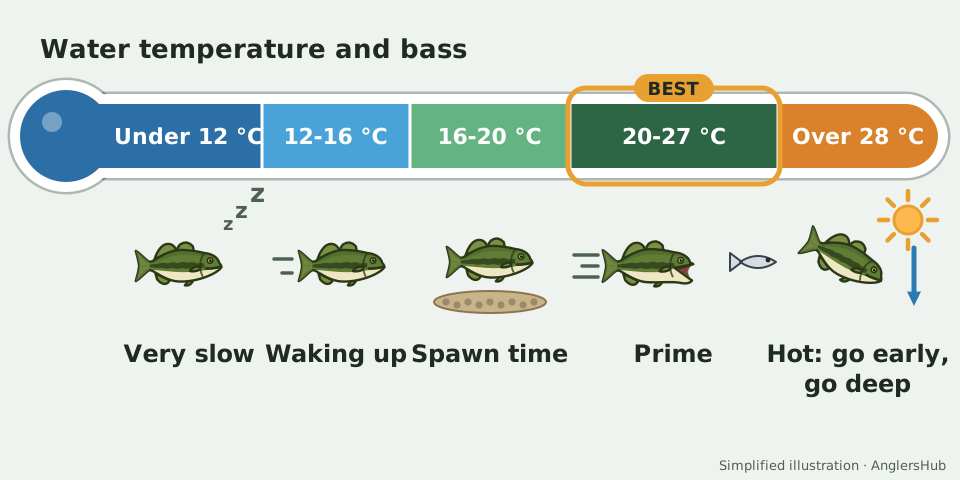
Under 12 °C: very slow
Bass eat rarely and move little. Fish the warmest hours with a small bait and long pauses. A bite or two is a good day.
12 to 16 °C: waking up
In spring, bass drift toward sunny, sheltered bays as the water warms. In autumn, as it cools through this band, they feed up for winter.
16 to 20 °C: spawn time
On the way up in spring, bass pair up and nest in the shallows. Pre-spawn females are at their heaviest.
20 to 27 °C: prime
Bass feed hard and spread out. Any of your three rigs can work, all day when it is cloudy.
Over 28 °C: hot
Feeding windows shrink to early, late and cloudy spells. At midday, "deep" means shade and the first drop-off, not the bottom of the dam.
Level up: carry a cheap digital pool or aquarium thermometer on a cord. Check 30 to 50 cm down at a few spots as you walk, and note it with every catch. In spring and winter a sunny, sheltered bay can run noticeably warmer than the main dam by the afternoon, and bass find it before you do.
Unlock Part 4 for free
Create a free AnglersHub account or sign in to read the rest of this part and every other part of the course. Your progress is saved to your account, so you can pick up on any device.
You come straight back to this guide afterwards.
South Africa's bass seasons
Most of inland South Africa gets its rain in summer and has dry, frosty winters. The Western Cape is the other way round: wet winters, dry summers. Bass follow the water temperature, not the calendar, so treat the months as a guide and your thermometer as the rule.
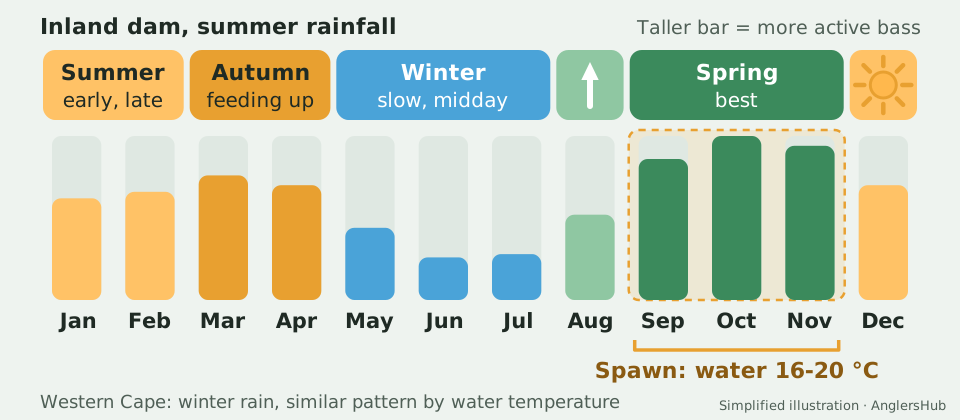
Spring (Sep to Nov): best
Warming water, hungry bass moving shallow to spawn. Fish sunny bays, reed lines and flats. The biggest fish of the year often come now.
Summer (Dec to Feb): early and late
Hungry fish, but hot, bright middays. Fish the first and last two hours of light, and shade in between. Leave at the first thunder.
Autumn (Mar to Apr): feeding up
Cooling water and plenty of young baitfish. Bass roam and feed hard. Some of the best fishing of the year.
Winter (May to Jul): slow, midday
Cold water, slow bass. Fish the warmest hours, slow right down, go smaller. Big bass are still caught, especially in warmer areas.
The spawn
Bass start nesting once the shallows hold above about 16 °C, and the spawn is in full swing from about 18 °C into the low 20s. FOSAF puts the South African peak in October, and on the Highveld it usually runs from September into November. Males fan out round nests on a firm bottom near cover, usually in under 2 m of water and often much shallower, then guard the eggs and the fry.
A guarding male hits almost anything near the nest. If you catch one, release it quickly where you caught it, so the nest is not left open to raiders. In the Western Cape, too, the spawn follows the spring warm-up.
Pick the right hours
Bass eyes work well in dim light, which gives them an edge over small fish at dawn and dusk. FOSAF notes bass feed most actively in the early morning and late afternoon. In summer those are your windows; in winter the warmth of the day matters more than the light.
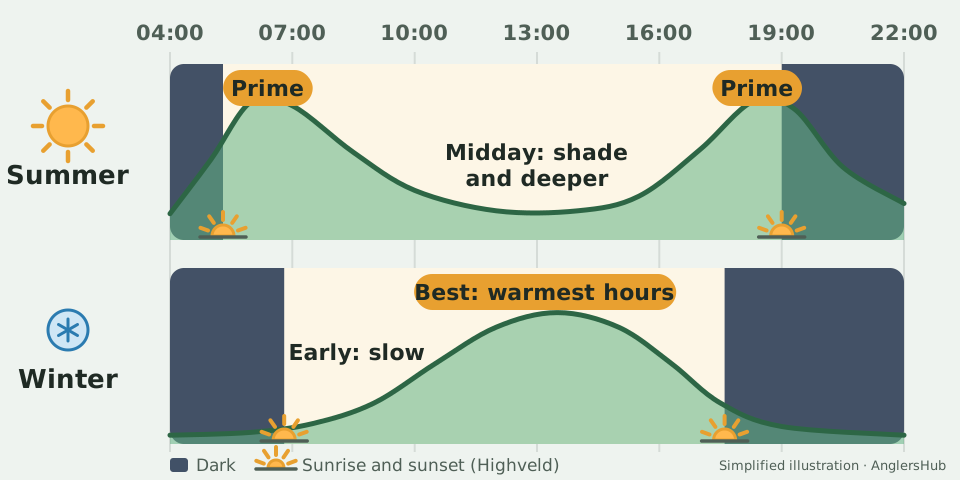
Summer day (Highveld, December)
- Sunrise about 05:15, sunset about 19:00.
- Prime: about 04:45 to 07:30, then 17:00 to dark.
- Midday: shade, the drop-off and slower baits.
- Afternoon storms often build after about 14:00.
Winter day (Highveld, June)
- Sunrise about 06:55, sunset about 17:30.
- Best: about 10:30 to 15:30, once the sun has warmed the shallows.
- A frosty dawn often means two cold hours with no bites.
The Cape sun rises and sets later (Cape Town's December sunset is close to 20:00). The Weather Hub shows golden hour for your exact spot.
Most common mistake: fishing the hours that suit you, not the fish. Arriving at 09:00 in December and leaving at 16:00 misses both prime windows. Set the alarm, or come back for the evening. In winter it is the opposite: skip the frosty dawn and fish after lunch.
Level up: in winter the sun sits low in the north. The shallows along a dam's southern shore (the bank that faces north) get sun for longest and are sheltered from the cold southerly wind behind a front. On a still winter afternoon, that is often the warmest water on the dam.
Weather: proven or folklore?
Every angler has a weather theory. Some hold up; some have never been shown to work. Here is the honest split.
Well supported
- Water temperature drives how much bass eat.
- Low light (dawn, dusk, heavy cloud) helps bass hunt.
- Wind pushes plankton and small fish onto the downwind bank.
- Muddy water makes bass hunt by feel more than sight.
- Lightning is a real danger on open water.
Unproven or folklore
- Bass feel the barometer and feed when it falls.
- The moon phase decides the daytime bite.
- Solunar tables tell you the hour fish will feed.
Cloud and wind
Overcast days stretch the dawn bite, and bass can stay shallow for hours. A breeze of about 5 to 25 km/h ruffles the surface, hides you and pushes food onto the bank it blows into. Above about 35 km/h, casting and seeing bites get hard, and small boats should stay in.
Cold fronts
Fronts reach South Africa from the south-west, mostly in winter. Ahead of one, the pressure falls, the wind picks up and it often turns warm or cloudy, and the bite can be good. Behind it, the wind swings round to the south-west or south, the temperature drops and the sky turns hard blue. Bass tuck into cover or slide a little deeper, and bites get shy.
Level up: after a front, go slow and small. Swap the 4 inch craw for a 3 inch one on a 2/0, pitch it into the thickest cover near your pre-front spots, and let it sit for 5 to 10 seconds. Fish the afternoon, when the sun has warmed the water. Many anglers find the second day after a front the hardest; the bite returns as the weather settles.
Myth: bass feel a falling barometer and go on the feed.
Fact: scientists have not shown that pressure on its own changes bass behaviour. The whole pressure change of a big front is about the same as a bass swimming 40 cm deeper, which it does all day. The bite before a front is real for many anglers, but the cloud, wind and light that come with the front explain it well enough.
The moon
There is no good evidence that the moon phase changes the daytime bite. Moonlight matters at night: in lab trials, bass caught most of their prey in full-moon light and almost none in total darkness. The Bite Score agrees: the moon phase adds nothing, and solunar times add only about 3 points, only at dawn or dusk.
Rain and muddy water
Heavy rain sends brown, often cooler water in through the inflows. Bass see less and hunt more by feel, using the lateral line along their sides. A dam that rises after good rain floods fresh grass, and bass move in to feed.
Level up: after rain, find the mud line where the brown inflow water meets clear dam water. Bass sit on the clear side and ambush what drifts out of the murk. Fish dark baits (black or dark purple) for a strong silhouette, and fish them slowly along that edge.
Storms: if you can hear thunder, you are close enough to be struck, and a carbon rod is a lightning conductor. Get off the water and the bank, into a car or a solid building, and wait 30 minutes after the last thunder.
Use the Weather Hub
The Weather Hub puts all of this on one page for your exact dam: hourly weather for the week, estimated water temperature, wind, pressure trend, sunrise and sunset, storm alerts and a Bite Score for every hour.
The Bite Score is a number from 0 to 100, worked out from the weather alone. Warm water, dawn and dusk, cloud and a light breeze add points; a cold front, a big pressure rise, gales and storms take them away. Water temperature counts most, and a likely storm takes off 25 points on its own.
Set your water and fish
Search your dam or drop a pin on your spot, and set Bite for to Bass.
Scan the week
Look for days tagged Best day or Good, and skip Storms days.
Read the dial
GO, CAUTION or NO-GO, with a one-line reason. Safety beats the score: a day can score 80 and still say CAUTION because of afternoon storms.
Plan around the best window
Be rigged and on the bank before it starts. Check the wind arrow and fish the bank it blows onto.
Check again
Look the night before and the morning you leave. If the weather models disagree, the details can still change.
What the Bite Score is not: it is a guide, not a promise, and it is not proven. It has not yet been tested against logged catches, and the water temperature is estimated from the air, not measured. It knows nothing about your bait, your spot or how many anglers fished that bank yesterday. A fair score on the right bank beats a great score on an empty one.
For the full tour, read the free guide How to Read the Weather Hub and Bite Score. For midsummer heat, the Science of Summer Bass (Pro) goes deeper on oxygen, thermoclines and storms.
Quick recap
- Water temperature first: 20 to 27 °C is prime, under about 12 °C is very slow.
- Spring (September to November inland) is the best season; the spawn starts as the shallows pass about 16 °C.
- Summer: first and last two hours of light. Winter: late morning to mid afternoon.
- Cloud and a light breeze help. After a cold front, go slower, smaller and tighter to cover.
- Barometer magic and moon phases are mostly folklore.
- After rain, fish the mud line with a dark bait.
- Check the Bite Score as a guide, and leave at the first thunder.
Plan your trip
- 1Check the Weather Hub and Bite Score for your dam.
- 2Pick a day and a two to three hour window around sunrise or sunset.
- 3Tell someone where you are going and when you will be back.
Finished Part 4?
Saved on this device. Create a free account to keep it on every device.
Sources for this partShow
- Florida Fish and Wildlife Conservation Commission. Temperature and fishing: preferred feeding and spawning temperatures by species. Read the page.
- Davis, J.T. and Lock, J.T. (1997). Largemouth bass: biology and life history. Southern Regional Aquaculture Center, SRAC Publication No. 200. Read the fact sheet (PDF).
- Texas Parks and Wildlife Department. Largemouth bass species profile: spawning temperature, nests and guarding. Species page.
- FOSAF (Federation of Southern African Flyfishers). The Basses, by Dean Impson: spawning season and feeding times in South Africa. Read the guide.
- Stuber, R.J., Gebhart, G. and Maughan, O.E. (1982). Habitat suitability index models: largemouth bass. US Fish and Wildlife Service, FWS/OBS-82/10.16.
- In-Fisherman. Barometric pressure and bass. Read the article.
- In-Fisherman. The effects of cold fronts on bass, with fisheries biologist Hal Schramm. Read the article.
- McMahon, T.E. and Holanov, S.H. (1995). Foraging success of largemouth bass at different light intensities. Journal of Fish Biology 46: 759 to 767.
- AnglersHub. How to Read the Weather Hub and Bite Score: how the score is built and what it cannot see.