Most of a dam holds no bass at all. The fish crowd onto a handful of edges: a reed line, a weed bed, a fallen tree, a rocky point. Learn to spot those edges from the bank and you stop casting at empty water.
Start with the right water, and be legal on it. Then read it the way a bass does: cover, edges, depth and light. Done in the right order, a two-hour walk round a small dam puts your bait in front of every spot worth fishing.
In 30 seconds
- Be legal: a provincial angling licence (in Gauteng from age 16), plus the owner's permission or a day ticket for private water.
- Start small: a 2 to 20 hectare farm or venue dam you can walk around.
- Bass live on edges: reeds, weed, fallen trees, rocks, jetties, the wall, inflows and the windy bank. Skip the open middle.
- Depth follows light and weather: shallow at dawn and dusk, the drop-off and shade at bright midday, a little deeper after a cold front.
- Walk, look, cast, move: 5 to 10 casts per spot, then on to the next one.
16+ age you need a licence in Gauteng
2 to 20 ha easiest dam size for a first bass
8 hotspots to check on any small dam
5 to 10 casts per spot, then move
Pick the right water
Sort out the paperwork before you think about lures. Each province sets its own angling rules, but three hold almost everywhere.
- A licence. In Gauteng anyone 16 or older needs a provincial angling licence and must carry it while fishing (Nature Conservation Ordinance 12 of 1983, section 74). Only the landowner, their family and some of their staff are exempt, so carry it at private venues too. In the Western Cape, CapeNature licenses angling in rivers and public dams such as Theewaterskloof; private farm dams there need permission only. Elsewhere, ask the provincial conservation authority or a tackle shop.
- Permission. Every farm dam, estate, club water and venue needs the owner's permission first. Most venues sell a day ticket, and many have their own rules on baits, fishing hours and keeping fish.
- Never move live fish. Putting live fish into any water needs a permit, and bass are a regulated alien species.
For your first bass, small beats big. A 2 to 20 hectare farm or venue dam lets you walk most of the bank in a morning and reach the fish with a short cast. Big dams like the Vaal hold plenty of bass, but far more empty water to sort through.
Good first water
- Small enough to walk around in two hours.
- Reeds, weed, trees or rocks along the bank.
- Clear to slightly coloured water: bass hunt mostly by sight.
- Bank angling allowed on at least half the shoreline.
Leave for later
- Huge open dams where you cannot reach the edges.
- Bare, round dams with mown grass to the waterline.
- Pea-soup green or chocolate-brown water.
- Rivers: harder to read, and stricter rules on bass.
Tip: search fishing spots for bass in your province, or open the map and sort by distance. Then look at the dam on a satellite view before you go: reed lines, weed beds, points and inflows show up clearly from above. A local tackle shop will know which dams are fishing well this month.
Unlock Part 3 for free
Create a free AnglersHub account or sign in to read the rest of this part and every other part of the course. Your progress is saved to your account, so you can pick up on any device.
You come straight back to this guide afterwards.
Read a dam like a bass
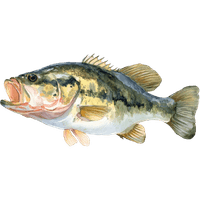
A bass is an ambush hunter. It waits next to something, out of sight, and lets food come past: a small fish, a frog, a freshwater crab. FOSAF describes largemouth bass as "very structure-orientated" for exactly this reason. So the question is never "where is the water?" but "where are the edges?"
Two words you will hear at the tackle shop. Cover is anything a bass can hide in or under: reeds, weed, a fallen tree, a jetty. Structure is a change in the shape of the bottom: a point, a drop-off, a channel, a rock pile. The best spots have both, like a weed bed on the lip of a drop-off.
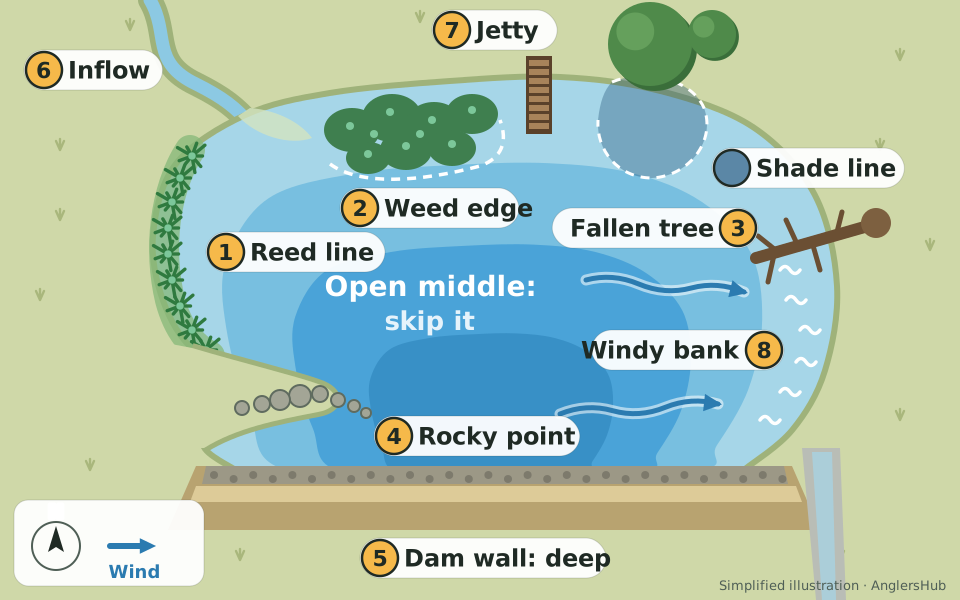
- Reed line. Bass sit on the outer edge and in the gaps, pockets and points of the reeds. Cast along the edge, not straight out, so the bait stays near the stems.
- Weed edge. The line where a weed bed stops and deeper water starts. Bass patrol it for small fish. A mojo rig swims a fluke just over the top; a Texas rig works the edge itself.
- Fallen tree. Shade and ambush points from trunk to tip. Start at the tip and work back, with a weedless Texas rig: an exposed hook snags.
- Rocky point. A point reaches into deeper water, so bass can move from shallow to deep without travelling far. Fish the tip and both sides. Rocks also hold crabs, a favourite bass food here.
- Dam wall. Usually the deepest water in reach of the bank, often lined with rock. Cast along the wall, not away from it, and obey any no-fishing signs.
- Inflow. A stream or pipe brings food, oxygen and, in summer, cooler water. Fish where the inflow channel meets the dam and along any colour change it makes.
- Jetty. Shade plus cover, so bass use it all day. Cast along the sides and let the bait sink next to the posts. Only fish jetties you are allowed on.
- Windy bank. Wind pushes surface food and small fish onto the bank it blows into, and bass follow. The ripple also breaks up the light and hides you. On a breezy day, start here, and cast across the wind with your rod tip low so the bow in your line does not hide bites.
Most common mistake: walking straight to the water's edge and casting out into the middle. You trample past the fish at your feet and land the bait in empty water. Stop a few metres back, fish the near edge first, then cast along the bank.
Myth: the big bass live out in the deep middle of the dam.
Fact: bass are homebodies that live on edges. In a Texas tracking study on two big reservoirs, most bass stayed within about 50 hectares all year, and 98% of locations were in water 9 m deep or less. On a small dam, most bass are within a long cast of the bank.
Level up: everyone fishes the big, obvious point. Look for secondary points: the smaller bumps and corners inside a bay, a kink in a reed line, a spur of rocks off a straight bank. Bass moving in and out of the bay pass them, and they see far fewer baits.
Level up: wear polarised glasses and look for the line where light sand or bright green weed turns dark. That colour change is your weed edge or drop-off. The fish sit on its irregular bits: a gap, a point of weed, an inside bend. Cast to those, not to the straight sections.
Shallow, drop-off or deep
From the bank, a small dam has three depth zones: the shallows (under about 1.5 m) with reeds and weed, the drop-off where the bottom slopes away, and the deep water beyond. Bass move between them through the day, and the drop-off is the road they travel on.
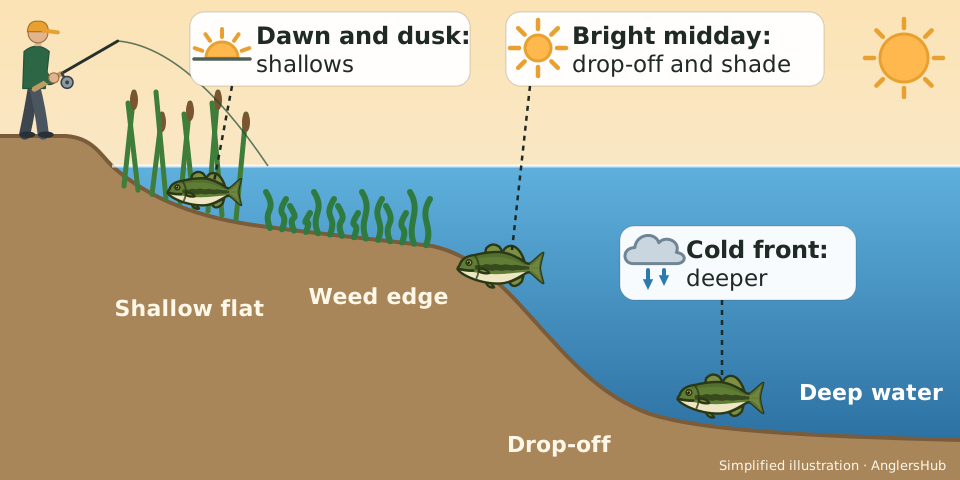
Dawn and dusk: shallow
In low light, bass move up onto the flats and along reed lines to hunt. Fish the shallows first, quietly, before you cast further out.
Bright midday: drop-off and shade
Sun pushes bass to the first drop-off, into weed and under shade. Fish the weed edge and the shady side of cover, and slow down.
After a cold front: deeper
Clear, cold, bright weather behind a front pushes bass to the base of the drop-off and into thick cover. Fish slowly and tight to it. Part 4 covers fronts.
You cannot see depth, but you can read it. The slope of the land usually carries on under the water: a steep bank drops off fast, a flat grassy bank means a wide shallow flat. Dark water close to the bank means depth close to the bank.
Tip: count your bait down. Cast a Texas rig and count the seconds until the line goes slack on the bottom. If the count jumps from 2 to 6 as you move along the bank, you have found the drop-off. Fish that stretch harder.
Level up: shade moves. In the morning it sits on the west side of trees, reeds and jetties; by afternoon it has swung to the east side. In midsummer the Highveld midday sun is almost straight overhead, so shade shrinks to what is directly under jetties, overhanging trees and weed mats. Fish the shady side, and move with it.
"Go deep in summer" needs care in South Africa. In green, nutrient-rich Highveld dams, the bottom water can run out of oxygen from about 6 m down in summer, so for a bank angler "deeper" means the first drop-off at 2 to 4 m, not the bottom of the dam. The Science of Summer Bass (Pro) explains why.
Plan your bank walk
A plan turns a wander into a search. On a 10 hectare dam, a slow loop of six to eight spots takes about two hours and tells you more than a whole day on one rock.
Map it at home
On a satellite view, mark six to eight spots from the hotspot list: reed lines, weed edges, points, the wall, the inflow, any jetty. Note which way the wind will blow on the Weather Hub.
Start where the light and wind say
At first light, start on the shallows and reed lines. If a breeze is up, start on the bank it blows onto. In bright midday sun, start on shade and weed edges.
Arrive quietly
Stop 2 to 3 m back from the edge, keep your shadow off the water and do not stomp. Bass in shallow water feel footsteps and spook from movement above them.
Look before you cast
Spend 30 seconds scanning with polarised glasses: weed edges, drop-offs, fry flicking at the surface, a bass sitting next to a post.
Fish it, then move
Give each spot 5 to 10 casts that cover it properly (Part 5 shows how), then walk to the next one. Bites come from new water, not from staring at old water.
Note what worked
A bite tells you the spot, the depth and the time. Good spots often hold more than one bass, so give it a few more casts, then look for spots like it.
Safety on the bank:
- Wet rocks, dam walls and jetties are slippery. Wear shoes with grip and do not climb steep walls alone.
- Reed beds hide soft mud and sudden drop-offs. Do not wade out to reach a spot.
- Look up before you cast: carbon rods conduct electricity, so stay well clear of overhead power lines.
- Watch where you step in long grass and reeds. Snakes like the same banks you do.
- Stay out of still, warm water in bilharzia areas (Limpopo, Mpumalanga, KwaZulu-Natal and the Eastern Cape especially), and keep well back from the edge wherever crocodiles or hippos occur.
- Tell someone where you are fishing and when you will be back.
Quick recap
- Licence where the province requires it (Gauteng: 16 and older), and permission or a day ticket for private water.
- Start on a small, walkable dam with reeds, weed, trees or rocks.
- Bass live on edges: reeds, weed, wood, rocks, jetties, the wall, inflows and the windy bank. Skip the open middle.
- Dawn and dusk shallow, bright midday on the drop-off and in shade, after a front deeper and slower.
- Read the water with polarised glasses: the light-to-dark line is your edge.
- Stand back, look first, give each spot 5 to 10 casts, then move.
- A bite means fish nearby: work the spot again and look for more like it.
Pick your water
- 1Sort out your licence, or permission for private water.
- 2Choose a dam or venue on AnglersHub.
- 3Mark three spots to fish first: cover, an edge and the windy bank.
Finished Part 3?
Saved on this device. Create a free account to keep it on every device.
Sources for this partShow
- FOSAF (Federation of Southern African Flyfishers). The Basses, by Dean Impson: introduction in 1928, distribution, habitat ("very structure-orientated") and regulations for alien fish. Read the guide.
- Gauteng Nature Conservation Ordinance 12 of 1983: section 74 (angling licences, age 16 and exemptions), section 75 (permission of the owner) and section 79 (releasing live fish).
- CapeNature. Recreational fishing permit (dams and rivers). Permit page.
- Texas Parks and Wildlife Department. Largemouth bass species profile: cover use and ambush feeding. Species page.
- Texas Parks and Wildlife Department telemetry study of largemouth bass on Toledo Bend and Lake Fork (home ranges, depths, dock use), as reported by Bassmaster.
- Anoxia in South African impoundments: a study of six hypertrophic dams near Gauteng and North West. Read the paper (PDF).
- Health-e News. Bilharzia: a silent disease lurking in our waters (endemic provinces). Read the article.