You can catch your first bass with about R1,500 of tackle. The trick is buying the right few things, not lots of things: one spinning rod and reel, a spool of decent line, two kinds of hook, three soft plastics and a handful of sinkers.
This part is your shopping list: exactly what to ask for, roughly what it costs, what to leave on the shelf, and how to set it up at home so your first trip is about fishing, not untangling. For carp and kurper gear, see the first fishing kit guide.
In 30 seconds
- One spinning combo: a 2.1 m (7 ft) medium power, fast action rod with a 2500 size reel.
- Line: 10 or 12 lb monofilament. Cheap, forgiving and easy to tie.
- Hooks: offset (EWG) hooks in 3/0 and 2/0, and wacky hooks in size 1 to 1/0.
- Baits and weights: 5 inch stick baits, 4 inch craws and flukes, bullet and cylinder sinkers of 3.5 to 7 g (1/8 to 1/4 oz), and bobber stoppers.
- At home: spool the reel without twist, and set the drag so line slips off with a firm, steady pull.
2.1 m (7 ft) medium power spinning rod
2500 reel size
10 or 12 lb mono line
About R1,500 to get fishing
Rod and reel: go spinning
Buy a spinning combo: a rod with the reel hanging underneath, cast by flipping open a wire arm called the bail. Spinning reels rarely tangle on a bad cast, and they throw light soft plastics easily, which is exactly what this course uses.
Spinning (buy this)
- The spool stays still, so a bad cast rarely makes a bird's nest.
- Casts light baits well, even a stick bait with no sinker.
- Most people cast it properly within an afternoon.
Baitcaster (later)
- The spool spins on the cast. Mistime your thumb and you get a backlash.
- Struggles with very light baits.
- Shines with heavier lures, thicker line and thick cover.
The rod
- Length: 2.1 m (7 ft). 1.98 m (6 ft 6 in) is fine too. Long enough to cast far, short enough to be accurate next to reeds and trees.
- Power: medium (M). It is printed near the handle, with a lure rating (look for one covering about 3.5 to 14 g, or 1/8 to 1/2 oz) and a line rating that covers 10 and 12 lb (often printed as 6 to 12 lb).
- Action: fast. The top section bends and the rest stays stiff, so it casts light baits and still drives a hook home.
Many budget combos here are sold as medium-heavy (MH). That suits Texas and mojo rigs on weedy dams; it just casts a weightless stick bait a little less far. Skip light (L) and ultralight (UL) rods for bass.
The reel
- Size 2500. Sizes differ a little between brands, so 2000 to 3000 is the window.
- Smooth beats fancy. Turn the handle in the shop: no grinding, no wobble. Feel matters more than the number of ball bearings on the box.
- Handle side. Most right-handers hold the rod in the right hand and wind with the left. The handle swaps sides.
A matched combo from a known brand costs roughly R600 to R1,500. Some come with line already on the reel.
Myth: serious bass anglers only use baitcasters.
Fact: top bass anglers carry spinning rods for light soft plastics, the same baits you will use in this course. A baitcaster is a tool for heavier lures, not a badge.
Unlock Part 1 for free
Create a free AnglersHub account or sign in to read the rest of this part and every other part of the course. Your progress is saved to your account, so you can pick up on any device.
You come straight back to this guide afterwards.
Line: start with mono
Line is the only thing between you and the fish, so skip the cheapest spool in the bin. Three types hang on the wall. Start with the first.
Monofilament (start here)
Stretchy, forgiving, easy to tie and cheap to replace. Buy 10 or 12 lb.
Fluorocarbon (as a leader)
Sinks, is harder for fish to see and shrugs off rocks. But it is stiff and springs off a small spinning spool in loops, so use it as a leader.
Braid (later)
Very thin for its strength, with almost no stretch, so you feel every touch. It floats, fish can see it, and it slips on a bare spool.
10 or 12 lb, nothing else. Fishing open banks and clear water? Take 10 lb: it casts a little further. Fishing near reeds, weed or rocks? Take 12 lb: it is tougher when a fish runs into cover. Do not go heavier on a 2500 reel: thicker line is springy, casts shorter and jumps off the spool. Replace mono at least once a season, because sun and heat weaken it, and cut off the first metre or two whenever it feels rough.
Level up: braid with a fluorocarbon leader. Once you fish soft plastics often, spool 15 to 20 lb braid and add 1 to 2 m of 10 or 12 lb fluorocarbon with an Albright knot. You feel every bite and cast further, and the fish only see the leader. Put a few turns of mono or a strip of tape on the bare spool first so the braid cannot spin.
Hooks, sinkers and soft plastics
This is the small stuff on the end of your line. Part 2 shows how it fits together into three rigs.
Hook sizes run backwards at first. From small to big: size 6, 4, 2, 1, then 1/0 (say "one-aught"), 2/0, 3/0. So a 3/0 is bigger than a 1/0.
- Offset hooks (EWG, extra wide gap): a pack of 3/0 for craws, stick baits and flukes, and a pack of 2/0 for when you downsize to smaller baits. The kink behind the eye locks the plastic in place, and the point is buried back in the bait so it slides through weed.
- Wacky hooks, size 1 to 1/0: short, strong hooks that go through the middle of a stick bait. Weedless ones, with a small fibre guard over the point, snag far less. Add a bag of O-rings, small rubber rings that make each bait last longer.
5 inch stick bait
A thick, heavy, salted worm (the Senko is the famous one). It sinks on its own with a slow, shimmying fall. The best first-bass bait there is.
4 inch craw
A soft plastic shaped like a crayfish, with two flat claws. It looks like the freshwater crabs bass hunt on our dams, and on a Texas rig it crawls through weed and reeds, claws flapping as it falls.
5 inch fluke
A soft, baitfish-shaped bait that darts and glides. On the mojo rig it swims above the weed while the sinker bumps the bottom.
Colours: green pumpkin (brown-green) and watermelon (lighter green) look natural in clear water. Add one dark colour (black, black and blue, or junebug purple) for coloured water and dull days. For flukes, white or pearl looks like a small baitfish.
Keep plastics in their own bags. Soft plastics can react with each other and with some hard plastic boxes, and melt into a sticky mess in a hot car.
- Bullet sinkers (Texas rig): pointed, so they slide through weed. Get 3.5 g (1/8 oz), 5 g (3/16 oz) and 7 g (1/4 oz), plus a couple of 10.5 g (3/8 oz) for wind and deeper water.
- Cylinder sinkers (mojo rig): long and slim, so they slide over rocks and through weed. 3.5 to 7 g (1/8 to 1/4 oz).
- Bobber stoppers: tiny rubber stops that grip the line, to pin the mojo sinker or lock a bullet against the hook. Pick a size made for line a little thinner than yours, so they grip tight.
Level up: lead or tungsten? Tungsten is much denser than lead, so a 7 g tungsten bullet is noticeably smaller. It slips through weed more easily and you feel every pebble through it, but it costs several times more. Start with lead, and add tungsten later for Texas rigs in thick weed.
Level up: EWG or straight shank? EWG hooks leave room for thick baits like stick baits and flukes, and are the best all-rounders for longer casts from the bank. Straight-shank (flipping) hooks hold a bait straighter and come through thick weed more cleanly, so they shine at short range in heavy cover.
The shopping list
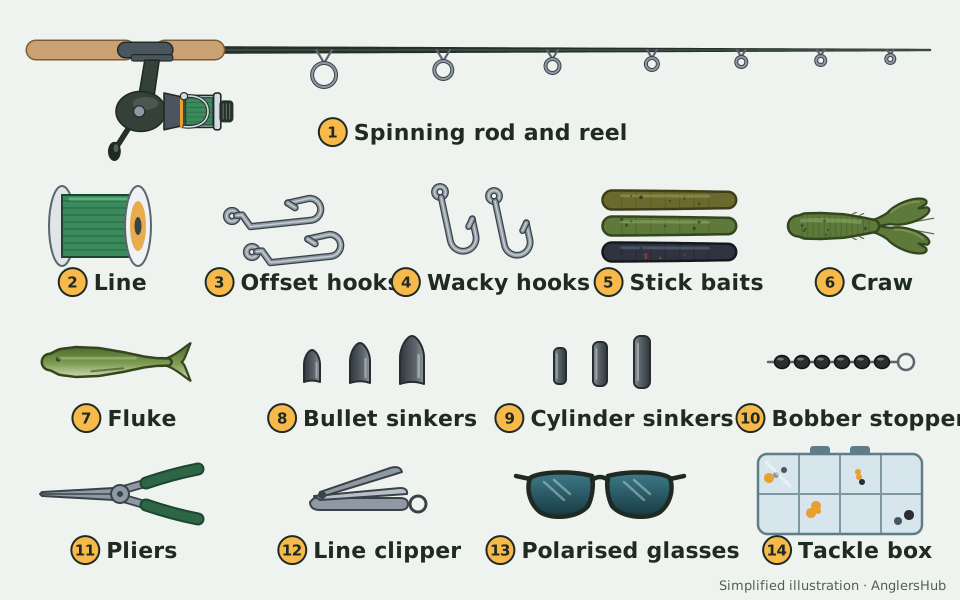
Take this list to the shop. These are rough prices, October 2026, and they vary by brand, shop and special. Skip anything you already own.
| Item | Ask for | Rough price |
|---|---|---|
| Spinning combo | 2.1 m (7 ft) medium, fast action, 2500 reel | R600 to R1,500 |
| Line (if not included) | 10 or 12 lb mono | R110 to R250 |
| Offset (EWG) hooks | 2/0 and 3/0, a pack of each | R60 to R150 |
| Wacky hooks and O-rings | Size 1 to 1/0, weedless if you can | R60 to R180 |
| Soft plastics | A pack each: stick baits, craws, flukes | R250 to R700 |
| Sinkers | Bullet and cylinder, 3.5 to 7 g (1/8 to 1/4 oz) | R80 to R200 |
| Bobber stoppers | Small rubber stops | R20 to R70 |
| Pliers | Long-nose, to unhook fish quickly | R100 to R300 |
| Line clipper | Or nail clippers from home | R0 to R80 |
| Polarised sunglasses | Brown or amber lenses for dams | R250 to R600 |
| Tackle box | Small clear box with dividers ("3600 size") | R60 to R200 |
A budget build comes to about R1,500; better gear throughout, nearer R3,000. Both catch bass. Polarised glasses earn their place: they cut the glare so you can see weed edges, drop-offs and fish, and they protect your eyes from a flying hook.
Licence money: public water needs a provincial angling licence, and private dams charge a day fee. Costs vary by province (CapeNature lists R45 for its licence). Part 3 covers the rules.
Skip for now
- A baitcaster. Great later, painful now.
- Hard lures. Crankbaits and topwaters catch bass, but they snag and cost far more to lose than a soft plastic.
- "Bass starter" boxes with a hundred random pieces. Most of it never gets used.
Tackle shop tips: go on a quiet weekday and say "I want to catch my first bass from the bank on soft plastics." Ask which dams are fishing well, which colours are working this month, and whether they will spool your reel when you buy the line (many do it for free). Find one on the shops page.
Set it up at home
Do this on the lounge floor, not at the dam. Twenty minutes at home saves an hour of tangles on the bank. If the shop spooled your reel, skip to the drag.
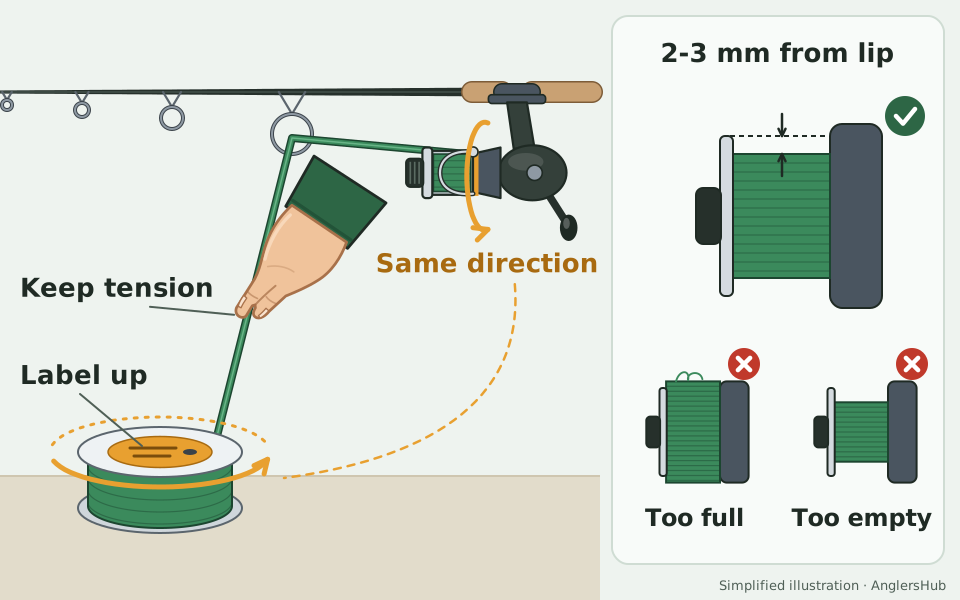
Tie on
Open the bail. Run the line through the big guide nearest the reel and tie it round the spool with an overhand knot, plus a second overhand in the tag so it cannot slip (an arbor knot). Trim and close the bail.
Label up
Lay the shop spool flat on the floor, label up, so the line comes off in the same direction the bail turns. That keeps the curl in the line matching the reel.
Keep tension
Pinch the line lightly between finger and thumb, or through a damp cloth, as you wind. Loose line digs in and tangles later.
Twist test
After 15 to 20 turns, lower the rod tip and let some slack hang. If it twists into curls, flip the shop spool over.
Stop at 2 to 3 mm
Fill until the line sits 2 to 3 mm below the lip of the spool.
Most common mistake: filling the spool to the brim. An overfilled spinning reel throws loose coils that turn into wind knots. Too little line is the opposite problem: casts fall short as the line drags over the lip.
The drag lets the reel give line when a fish pulls hard, so the line slips instead of snapping. Too loose and you cannot set the hook. Too tight and a big fish snaps the line. You set it by feel, pulling line off by hand.
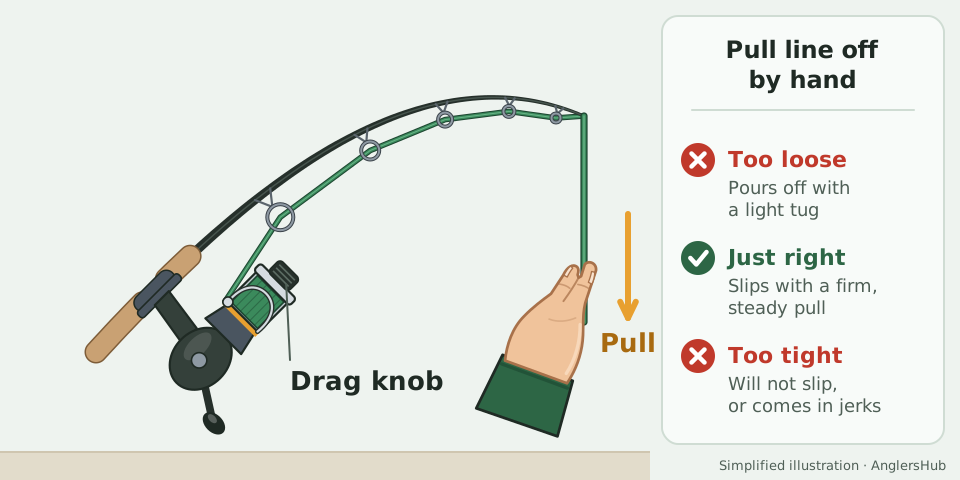
Close the bail
Flip the bail over so the line is locked, and hold the rod up with a bend in it, like you are fighting a fish.
Pull line off the tip
Grab the line below the tip with your other hand and pull down, hard and steady.
Adjust the knob
Pours off with a light tug? Tighten the knob on the front of the spool a little. Will not slip at all? Loosen it. Stop when line slips smoothly, but only when you really pull.
Tip: check it again at the water before your first cast. Drags creep, and a reel that sat in a hot car can feel different.
Quick recap
- A spinning combo: 2.1 m (7 ft), medium power, fast action, 2500 reel.
- 10 or 12 lb mono (12 lb near cover), changed every season.
- EWG hooks in 2/0 and 3/0, wacky hooks in size 1 to 1/0, and O-rings.
- Stick baits, craws and flukes in green pumpkin, watermelon and one dark colour.
- Bullet and cylinder sinkers of 3.5 to 7 g (1/8 to 1/4 oz), plus bobber stoppers.
- Pliers, clippers, polarised glasses, a small box and licence money.
- Spool label up, stop 2 to 3 mm below the lip, and set the drag so line slips with a firm, steady pull.
Get your kit ready
- 1Buy what is on the shopping list, or check the kit you already own against it.
- 2Spool your reel with fresh line, the right way round.
- 3Set your drag by hand: line should slip with a firm, steady pull.
Finished Part 1?
Saved on this device. Create a free account to keep it on every device.
Sources for this partShow
- Shimano. Rod action and power explained. Article.
- FishUSA. How to spool a spinning reel (twist test, filling to about 3 mm below the rim, mono backing or tape under braid). Guide.
- Wired2Fish. How to set the drag on fishing reels (20 to 30 percent of line strength). Article.
- Wired2Fish. When to use offset and EWG vs straight shank hooks. Article.
- Wired2Fish. 3 unique ways to use a bobber stopper for bass fishing (sizing stoppers to your line). Article.
- CapeNature. Angling licences. Permit page.
- Prices: a rough guide from South African tackle shop listings in October 2026. They vary by brand, shop and special.