
One knot and three rigs will catch bass on almost any dam in South Africa. The Palomar ties on your hook. The Texas rig goes into weed and snags, the wacky rig sinks slowly along clean edges, and the mojo rig swims a bait over the top of a weed bed.
This part shows you how to tie each one, which hook and sinker goes with which bait, how to get the plastic dead straight, and how to pick a rig at the water. Do it at home first, with a bucket of water to test in.
In 30 seconds
- Palomar knot: double the line, tie an overhand, pass the loop over the hook, wet it, pull tight.
- Texas rig: a bullet sinker and a 3/0 EWG hook with the point buried in a craw. For weed, reeds and snags.
- Wacky rig: a size 1 to 1/0 hook through the middle of a 5 inch stick bait, no sinker. For clean banks and edges.
- Mojo rig: a cylinder sinker pinned between two stoppers, 30 to 60 cm above a fluke. For submerged weed beds.
- Rig it straight. A bait that spins looks wrong to a bass and twists your line.
1 knot the Palomar
3 rigs Texas, wacky, mojo
3.5 to 7 g (1/8 to 1/4 oz) sinkers for most days
30 to 60 cm mojo sinker to hook
The one knot: Palomar
The Palomar is strong, quick and hard to get wrong, and it keeps about 90% of your line's strength in angler tests. Tie every rig in this part with it. It is all one line: the pictures colour the main line green and the tag end gold so you can follow each strand.
Thread first, tie second. Sinkers and stoppers go on the line before you tie on the hook. Forget, and you cut the knot off and start again.
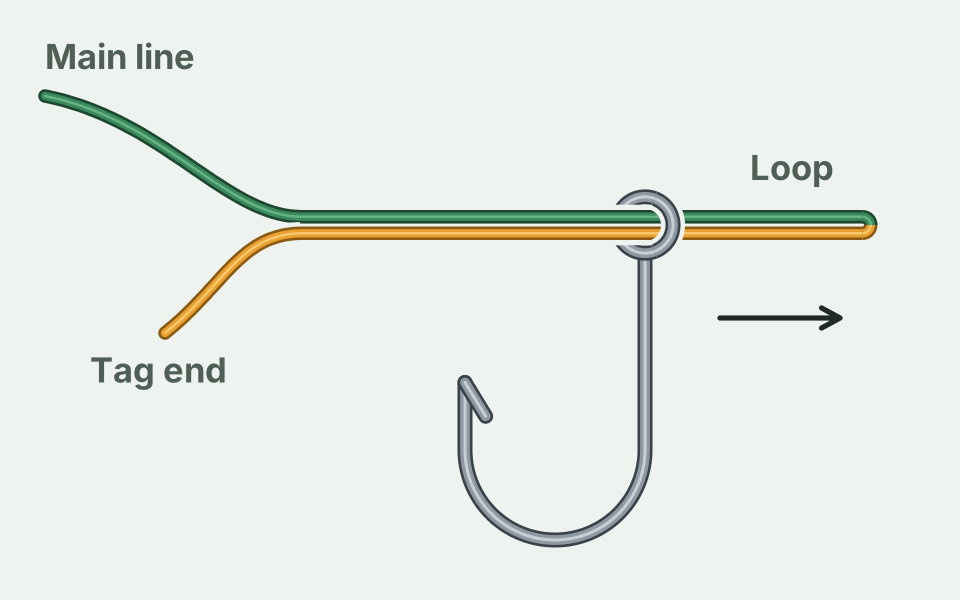
Double and thread
Fold about 15 cm of line back on itself and push the loop through the hook eye.
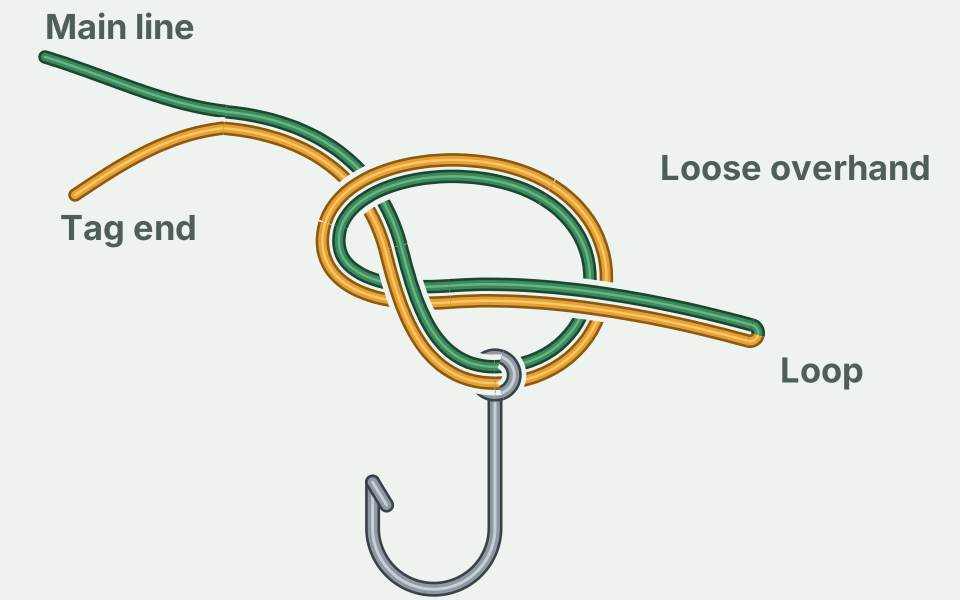
Loose overhand
Tie a simple overhand knot with the doubled line and let the hook hang. Keep the two strands flat, side by side.
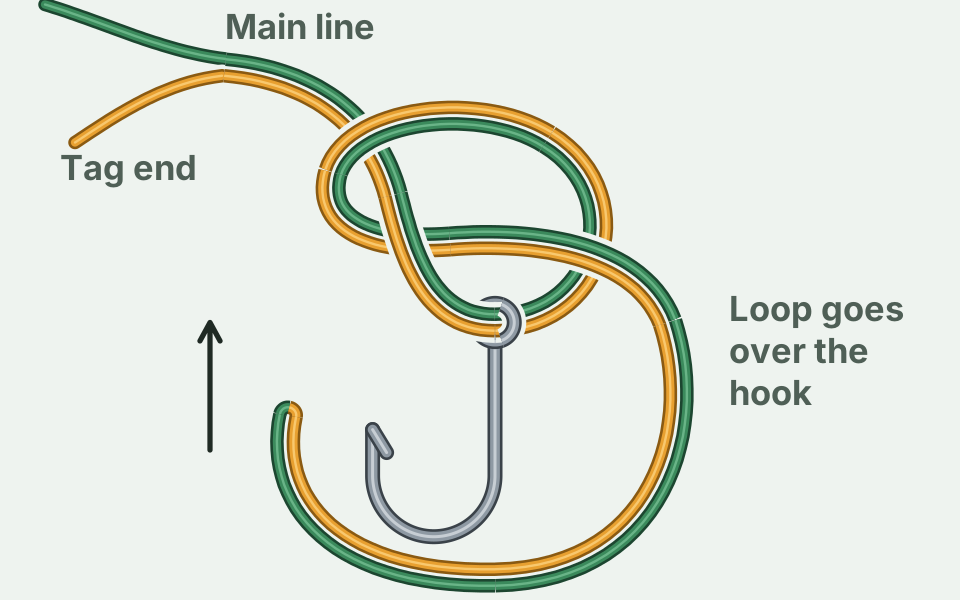
Loop over the hook
Pass the end of the loop right over the hook so it sits above the eye.
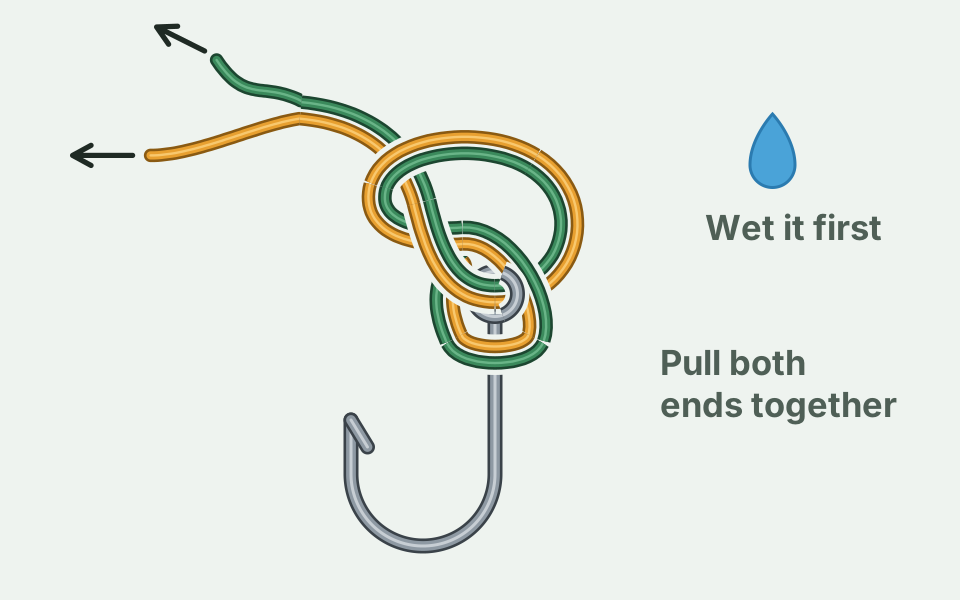
Wet and tighten
Wet the knot with spit or dam water, then pull the main line and tag together. The knot slides down snug onto the eye.
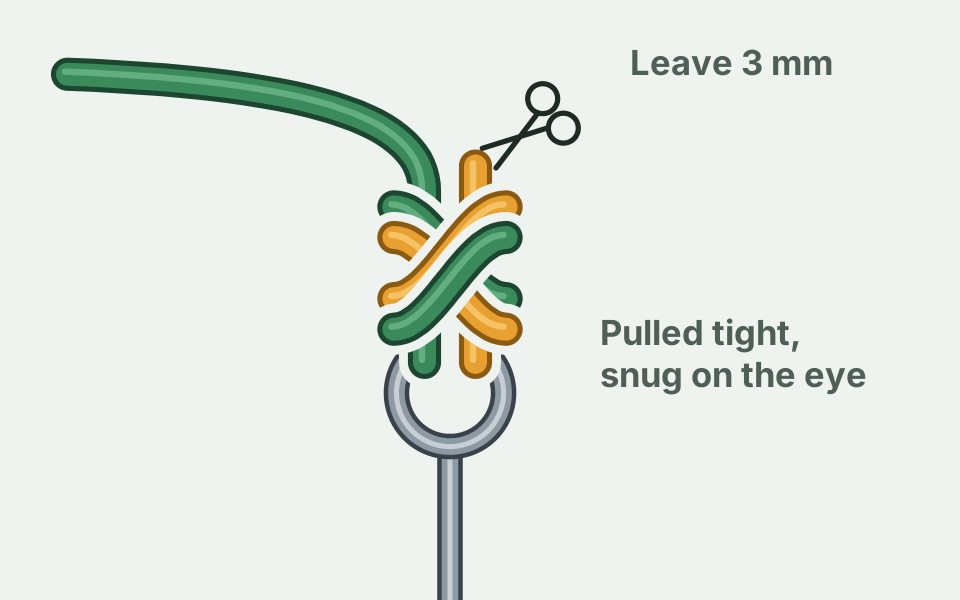
Trim
Cut the tag, leaving about 3 mm. Then pull hard on the main line to test it.
Watch for twisted strands in step 2. If the two lines cross over each other, the knot bites into itself and breaks early. A dry knot is weak too: friction heat damages mono as you pull it tight.
Tip: tie it five times at home with an old hook and you will tie it without looking by the weekend. The full Palomar knot guide has more pictures and when to use another knot.
Unlock Part 2 for free
Create a free AnglersHub account or sign in to read the rest of this part and every other part of the course. Your progress is saved to your account, so you can pick up on any device.
You come straight back to this guide afterwards.
Texas rig: for weed and snags
A bullet sinker slides on the line in front of an offset (EWG) hook, with the point buried back in the bait. Nothing sticks out to catch weed, so you can drop it into reeds, weed beds, sunken trees and rocks, right where bass hide. Use a 4 inch craw on a 3/0 EWG hook (a 5 inch stick bait works the same way) and a 5 g (3/16 oz) bullet to start. The claws trail behind, like a crayfish backing away.
Sinker on
Slide on a bullet sinker with the pointed end facing up the line, towards the rod. Tie on the hook with a Palomar.
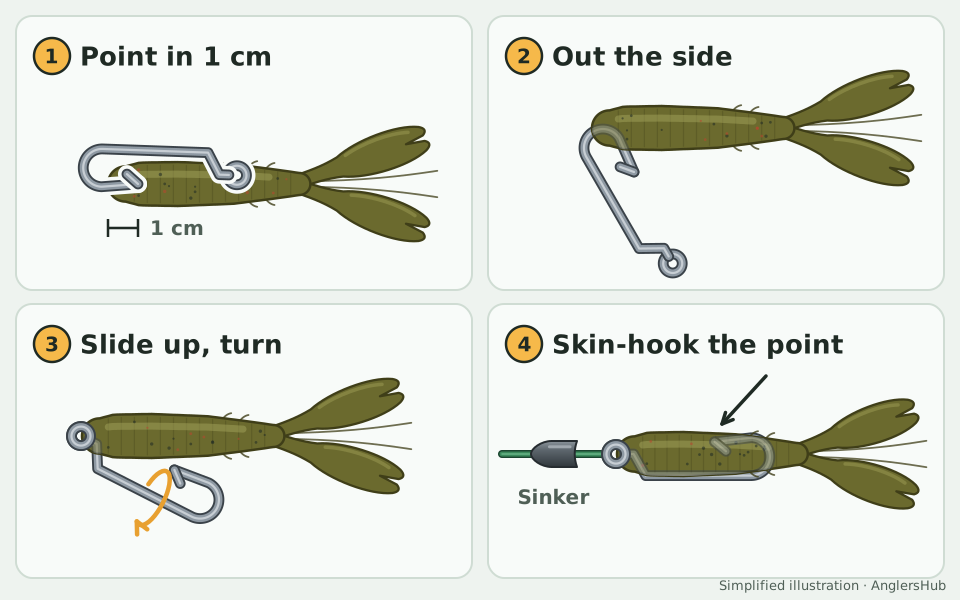
Point in 1 cm
Push the hook point into the centre of the craw's blunt end (the end without claws), about 1 cm deep (roughly the length of the hook's kink).
Out the side
Bring the point out of the side of the craw, then pull the hook through until the eye reaches the blunt end.
Slide up, turn
Slide the blunt end up over the eye so the kink sits snug inside it, then turn the hook round so the point faces the craw.
Skin-hook the point
Lay the hook along the craw to see where the point meets the body. Push the point into the body there and stop when it sits just under the skin on the other side.
Most common mistake: a bunched or bent craw. It spins as you reel, twists your line and looks wrong to a bass. Hold the rig up by the line: the craw should hang straight. If it bends, move the point a few millimetres and push it in again.
Pick the lightest sinker you can still feel on the bottom. As a rough guide for bank fishing:
| Bullet | Use it for |
|---|---|
| 3.5 g (1/8 oz) | Calm days and shallow water under about 1.5 m. Slowest fall. |
| 5 g (3/16 oz) | Your starting point, about 1 to 3 m. |
| 7 g (1/4 oz) | A breeze, or water about 3 to 5 m deep. |
| 10.5 g (3/8 oz) | Strong wind, deeper water, or pushing through thick weed. |
Level up: peg it in heavy cover. Slide a bobber stopper on before the sinker, then push it down against the sinker once the hook is tied. Sinker and craw now go through weed and reeds together. In open water, leave the sinker free so the craw falls more slowly behind it.
Level up: Tex-posed. Push the point right through and rest it flat on the surface of the plastic. It stays fairly weedless and hooks more soft biters, because the point does not have to punch through plastic first.
Wacky rig: the slow fall
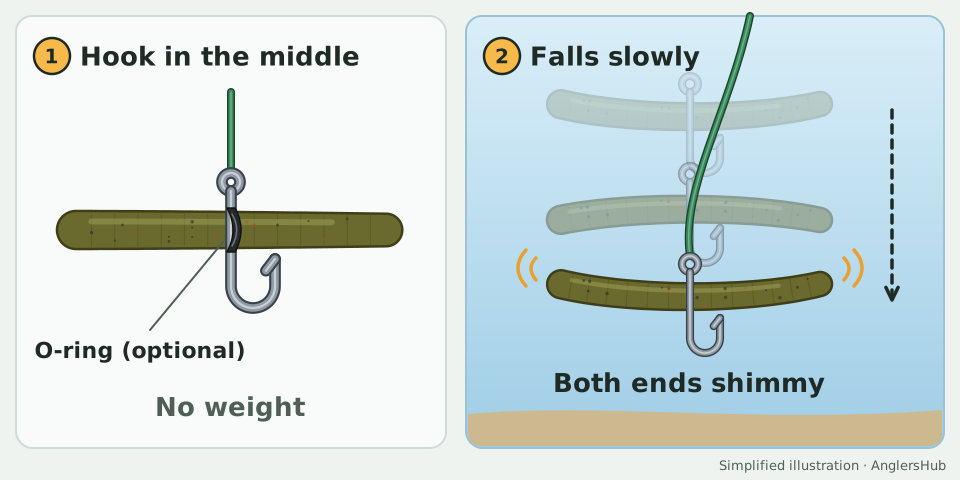
The simplest rig there is: a hook through the middle of a 5 inch stick bait, and no sinker. It sinks slowly and level, both ends shimmying, and bass grab it on the way down. Use it along clean banks, jetties, the outside edge of reeds and over sunken weed.
Tie on
Tie a size 1 to 1/0 wacky hook to the line with a Palomar. Use a weedless one if there are branches or snags about.
Find the middle
Balance the stick bait across one finger. The balance point is where the hook goes, so the bait falls level.
O-ring on
Roll an O-ring onto the bait at that point. A cheap O-ring tool makes it easy. You can skip this step, but your baits tear sooner.
Hook under the ring
Slide the hook point under the O-ring, across the bait, and leave the point exposed. No ring? Push the hook straight through the middle of the bait.
Level up: O-rings and weedless wacky hooks. Stick baits are soft, so a hook through the plastic tears out after a fish or two. The O-ring takes the strain, and one bait lasts several fish. A weedless wacky hook lets you drop it beside sunken branches without snagging every cast.
Level up: add a nail weight. On windy days, or to get down faster, push a small nail weight (about 0.9 to 1.8 g, 1/32 to 1/16 oz) into one end of the stick bait. It casts further and sinks quicker. Move the hook a little towards the weighted end and you have a Neko rig, which stands the bait on its head on the bottom.
Mojo rig: over the weed
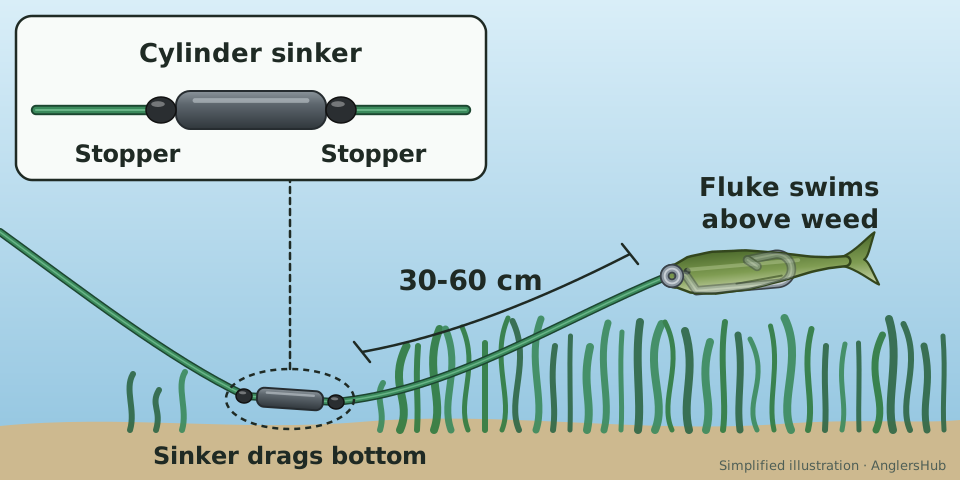
A slim cylinder sinker is pinned on the line between two bobber stoppers, 30 to 60 cm above a hook with a fluke. The sinker slides along the bottom and through the weed, while the bait follows behind and swims above it. It is very popular on South African dams, especially where submerged weed covers the bottom.
First stopper
Stoppers come on a little wire loop. Push the end of your line through the loop and slide one stopper off the wire onto the line.
Sinker
Slide on a cylinder sinker of 3.5 to 7 g (1/8 to 1/4 oz). Go lighter in calm, shallow water and heavier in wind.
Second stopper
Slide a second stopper onto the line below the sinker.
Hook and fluke
Tie on a 3/0 EWG hook and rig a 5 inch fluke Texas-style, with the point coming out of the slot on its back.
Set the gap
Wet the line, then slide the stoppers and sinker 30 to 60 cm up from the hook, sinker snug between the stoppers. Go longer over taller weed.
Level up: trim the fluke to fit. A fluke must swim upright. If it rolls onto its side, the hook is off-centre. If the point lands in front of the slot on its back, pinch 3 to 5 mm off the nose so the point lines up, rather than forcing a bend into the bait.
Level up: mojo to Texas in seconds. Slide the stoppers and sinker down to the hook and you have a pegged, weedless rig for thick cover. Slide them back up for open weed. If the sinker pushes the stopper down on the cast, add a second stopper and lob it out gently.
Which rig, when
Look at the water in front of you and pick the rig that suits it.
Texas rig
See: reeds, thick weed, sunken trees, rocks.
4 inch craw or a stick bait on a 3/0 EWG, with a 5 to 7 g bullet.
Wacky rig
See: clean banks, jetties, reed edges, shallow open water.
5 inch stick bait on a size 1 to 1/0 wacky hook, no sinker.
Mojo rig
See: weed below the surface, wide flats, water about 2 to 5 m deep.
5 inch fluke on a 3/0 EWG, with a 3.5 to 7 g cylinder 30 to 60 cm up.
Cannot decide? Start with the wacky rig on the first clean bank and switch to Texas when you reach weed or reeds. Part 5 covers how to work each rig.
Myth: a heavier sinker gets your bait down to the bass, so it catches more.
Fact: a heavy sinker drops the bait fast, and bass see it for less time. Many bites come while the bait is falling. Use the lightest sinker you can still feel on the bottom.
Level up: match the sinker to wind and depth. If wind bows your line and you lose touch with the bottom, go up one size. If you snag every cast, or the bait drops like a stone, go down one. On a windy day the right size can change by the hour.
Practise at home
- Tie five Palomar knots and pull-test every one, hard.
- Rig one of each and drop them into a bucket or the bath. The Texas craw should fall straight, the wacky bait level with both ends wobbling, and the fluke upright.
- Fit O-rings to three stick baits now, so they are ready at the dam.
- Pack a rig box: one compartment each for Texas, wacky and mojo, with that rig's hooks, sinkers, stoppers (still on their wire) and baits. Changing rigs on the bank then takes two minutes, not ten.
Quick recap
- Thread sinkers and stoppers on first, then tie the hook with a wet, untwisted Palomar.
- Texas rig: bullet pointed up the line, 2/0 or 3/0 EWG, point skin-hooked, craw dead straight.
- Wacky rig: size 1 to 1/0 hook at the balance point of a 5 inch stick bait, ideally under an O-ring.
- Mojo rig: stopper, cylinder sinker, stopper, then 30 to 60 cm to a 3/0 hook and fluke.
- Weed and snags: Texas. Clean edges: wacky. Submerged weed beds: mojo.
- Use the lightest sinker you can feel on the bottom, and go heavier in wind.
Rig up at home
- 1Tie five Palomar knots and pull-test every one.
- 2Rig a Texas rig, a wacky rig and a mojo rig.
- 3Pack a spare of each, ready to tie on at the water.
Finished Part 2?
Saved on this device. Create a free account to keep it on every device.
Sources for this partShow
- AnglersHub Academy. How to tie the Palomar knot. Knot guide.
- Tackle Warehouse. How to rig a Texas rig (pegging in heavy cover, free weight in open water). Guide.
- Wired2Fish. 6 ways to use a bullet weight for bass fishing. Article.
- Wired2Fish. The wacky rig: how to rig and fish guide. Guide.
- Wired2Fish. 3 unique ways to use a bobber stopper for bass fishing. Article.
- Bass Pro Shops. How to stop worm weights from sliding. Article.
- BassResource. The mojo rig (split shot rig). Video and article.