Papgooi is how most South Africans catch their first carp. You mould a fist-sized lump of stiff mielie meal pap around a weighted spring, cast it out, and put the rod on a rest. On the bottom the pap slowly breaks down into a cloud of food, carp move in to feed on it, and one of them sucks in the little bait sitting in the middle of it all.
It is simple, cheap and it works on almost every dam in the country. But it needs different kit from bass fishing: a longer, stronger rod, a reel that lets a carp take line, and a few carp-specific bits. This part is your shopping list, what it roughly costs, what to leave on the shelf, and how to set it up at home.
In 30 seconds
- Rod: a 3.6 m (12 ft) carp rod with a 3 lb test curve.
- Reel: a freespool (baitrunner) reel, size 5000 to 6000.
- Line: 15 lb monofilament. Go up to 20 lb near reeds and snags.
- End tackle: ready-made papgooi spring traces of 40 to 60 g with two hooks, and a packet of millies (soft floats).
- Bait: a bag of mielie meal and a bottle of flavour.
- On the bank: two rod rests, a big landing net and an unhooking mat.
3.6 m (12 ft) carp rod, 3 lb test curve
Freespool reel, size 5000 to 6000
15 lb mono line
About R2,500 to get fishing
The rod: long and soft enough to cast pap
A papgooi spring with its ball of pap weighs well over 100 g. A carp rod is built to throw that weight a long way without snapping, and to soak up the long runs of a big fish.
- Length: 3.6 m (12 ft). This is the standard papgooi rod. On a small farm dam a 3 m (10 ft) rod is fine and easier to handle; on big dams some anglers go to 3.9 m (13 ft).
- Test curve: 3 lb. Printed on the rod near the handle, often as "12ft 3lb". It tells you how stiff the rod is. 2.75 to 3.5 lb all work; 3 lb is the sweet spot for papgooi.
- Big guides. A large first guide (the one nearest the reel) lets line pour off on the cast.
Myth: you can throw pap with any rod.
Fact: a bass or kurper rod is rated for lures of 10 to 20 g. Cast a 150 g lump of pap on it and you risk breaking the rod, and the pap flies off long before the rod can load up. Use a proper carp rod.
Unlock Part 1 for free
Create a free AnglersHub account or sign in to read the rest of this part and every other part of the course. Your progress is saved to your account, so you can pick up on any device.
You come straight back to this guide afterwards.
The reel: freespool is the key
When a carp picks up the bait it often bolts, and a rod lying on a rest can be pulled straight into the water. A freespool reel (also sold as a baitrunner, after the first famous one) stops that. It has a second, very light drag that you switch on with a lever at the back. With freespool on, a running carp takes line freely. Turn the handle and the reel snaps back to the main drag, ready to fight the fish.
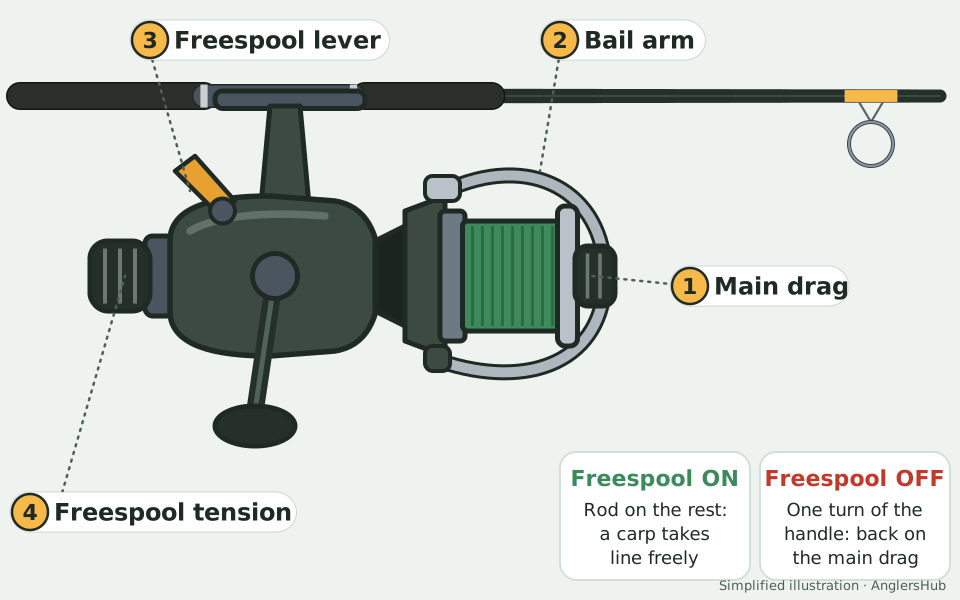
- Size 5000 to 6000. Sizes differ between brands. Check the spool holds at least 200 m of 15 lb line.
- Front drag. Almost all freespool reels have the main drag knob on the front of the spool. That is the one you set by hand below.
- Turn the handle in the shop. It should feel smooth, with no grinding. Flick the freespool lever on and off a few times: it should click cleanly both ways.
A matched carp combo (rod and freespool reel) costs roughly R1,200 to R2,500. Most South African anglers fish two rods once they get going. One is plenty for your first trip.
Level up: a second rod. Two rods means two baits in the water, and you can try two spots or two hookbaits and see which one the carp want. Buy the same combo twice so the casting feels identical. Check the venue rules first: some allow two rods, some only one, and some more.
Line: 15 lb mono
Buy 15 lb monofilament in a dull green or brown. Mono stretches, which cushions a carp's first lunge, and it is easy to tie and cheap to replace. Fishing near reeds, sunken trees or rocks, where a carp will try to bury itself? Go up to 20 lb. Replace it at least once a season, because sun and heat weaken it, and cut off the first few metres whenever it feels rough.
Do not fish light line for carp. Line of 8 to 10 lb that is perfect for kurper will snap on the cast with a ball of pap, or on the first run of a 5 kg carp. A break-off leaves a fish trailing your rig.
Level up: a shock leader. Once you start casting hard on big dams, tie on about 10 m of 30 lb mono as a leader with a double uni knot. The cast puts most of its strain on the first few metres of line, and the leader takes it. Ask your tackle shop to show you.
The end tackle: spring traces and millies
This is the small stuff on the end of your line. Part 2 shows how it fits together.
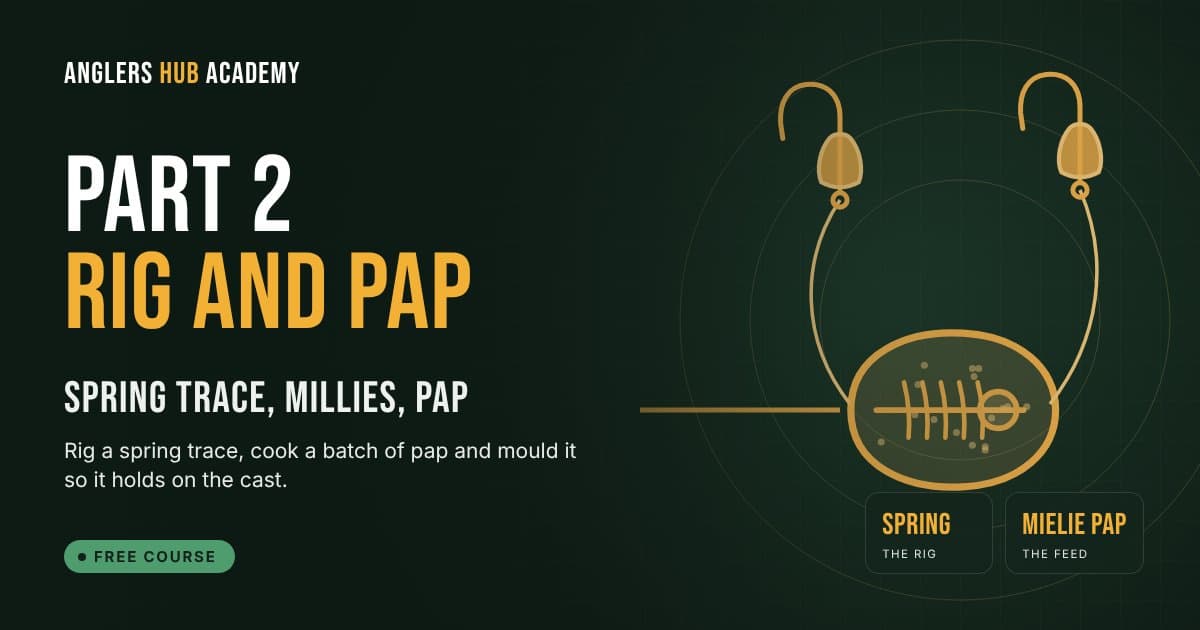
Papgooi spring trace
A ready-made trace from the tackle shop: a wire spring with a lead weight that the pap is moulded around, and two short hook links on swivels, one at each end. Buy 40 to 60 g; 40 g for small dams, 60 g for wind and long casts. Buy a few: you will lose some in snags.
Millies (soft floats)
Soft foam baits shaped like mielie pips, in yellow, white, pink and orange. Push one onto each hook. They float, so the hook sits just above the pap where a feeding carp sucks it in, and small fish cannot strip them.
- Snap swivels: size 8 or 10. Tie one to the end of your main line and clip it to the spring trace. Changing a trace then takes seconds.
- Spare hooks: a pack of size 8 hooks, for when a hook on a trace gets blunt or bent.
Bait: mielie meal and flavour
The beauty of papgooi is that the bait comes from the supermarket.
- Mielie meal: a 1 kg bag of ordinary super maize meal, not instant. That is one batch of pap.
- Flavour: a bottle of carp essence or flavouring from the tackle shop. Sweet flavours like strawberry, banana, vanilla, caramel and Scopex are South African favourites. Pick one and stick with it for now.
- A ready-made pap mix (optional): tackle shops sell bags of flavoured papgooi mix that you only mix with water. It costs more, but it is a good way to start if you do not want to cook.
On the bank
Carp are big, strong fish. These items are there to land them and keep them safe.
- Two rod rests (bank sticks with rest heads), or a rod pod. The rod sits on them while you wait. A pod stands on hard ground and concrete; bank sticks push into soft ground.
- A landing net with arms of at least 42 inches (107 cm). A bass-sized net is far too small for a big carp.
- An unhooking mat. A padded mat for the fish to lie on while you take the hook out. Many carp venues insist on one.
- Forceps or long-nose pliers to unhook the fish, and scissors or a line clipper.
- A bucket with a lid for the pap, and a cloth to wipe your hands.
Level up: bite alarms. A bite alarm is an electronic rest head that beeps when line moves over it. With a hanger (a small weight clipped on the line below the reel) it shows every touch, even a fish swimming towards you. It lets you relax, cook and even nap, and it is what nearly every carp angler uses. Your reel's freespool clicker does the job for a first trip.
The shopping list
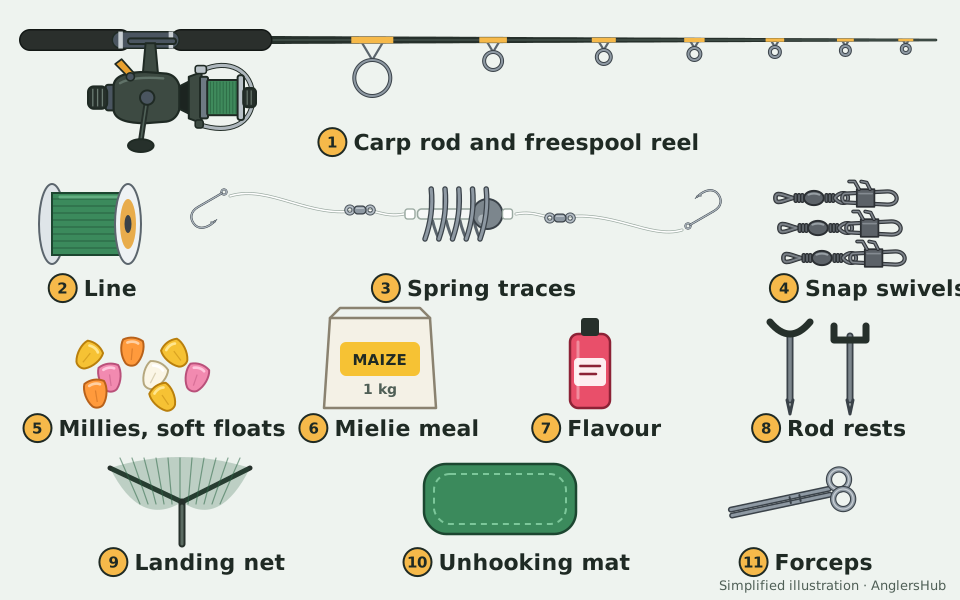
Take this list to the shop. These are rough prices, October 2026, and they vary by brand, shop and special. Skip anything you already own.
| Item | Ask for | Rough price |
|---|---|---|
| Carp combo | 3.6 m (12 ft) 3 lb carp rod, freespool reel 5000 to 6000 | R1,200 to R2,500 |
| Line (if not included) | 15 lb mono, at least 300 m | R150 to R300 |
| Papgooi spring traces | Ready-made, 40 to 60 g, two hooks, three or four | R80 to R200 |
| Snap swivels and spare hooks | Size 8 or 10 snap swivels, size 8 hooks | R40 to R100 |
| Millies (soft floats) | A mixed packet | R40 to R90 |
| Mielie meal and flavour | 1 kg super maize meal, one essence | R80 to R150 |
| Rod rests | Two bank sticks and rest heads, or a pod | R150 to R800 |
| Landing net | 42 inch (107 cm) arms, with a handle | R350 to R900 |
| Unhooking mat | A padded carp mat | R300 to R700 |
| Forceps and clipper | Straight or curved forceps | R60 to R150 |
A budget build comes to about R2,500 to R3,000; better gear throughout, nearer R5,000. Both catch carp. Licence money: public water needs a provincial angling licence, and private dams and carp venues charge a day fee. Part 3 covers the rules.
Skip for now
- A bivvy, a bedchair and a carp barrow. Great for overnight sessions. Not needed for your first day trip.
- Boilies, pellets and a cupboard of liquids. Pap and millies catch carp all over South Africa. Keep it simple until you are catching.
- Braid main line. It has no stretch, so hooks pull out of a lunging carp at close range. Stick with mono.
Tackle shop tips: say "I want to start papgooi from the bank." Ask which dams are fishing well, which flavour the local carp like at the moment (shops know), and whether they will spool your reel when you buy the line. Find one on the shops page.
Set it up at home
Do this at home, not on the bank. Twenty minutes in the garden saves an hour of fiddling at the dam.
Spool up
Fill the reel with 15 lb mono to 2 to 3 mm below the lip of the spool, with the shop spool lying label up so the line comes off the way the bail turns. Keep light tension on the line as you wind. A freespool reel holds a lot of line, so let the shop do it if they offer.
Set the main drag
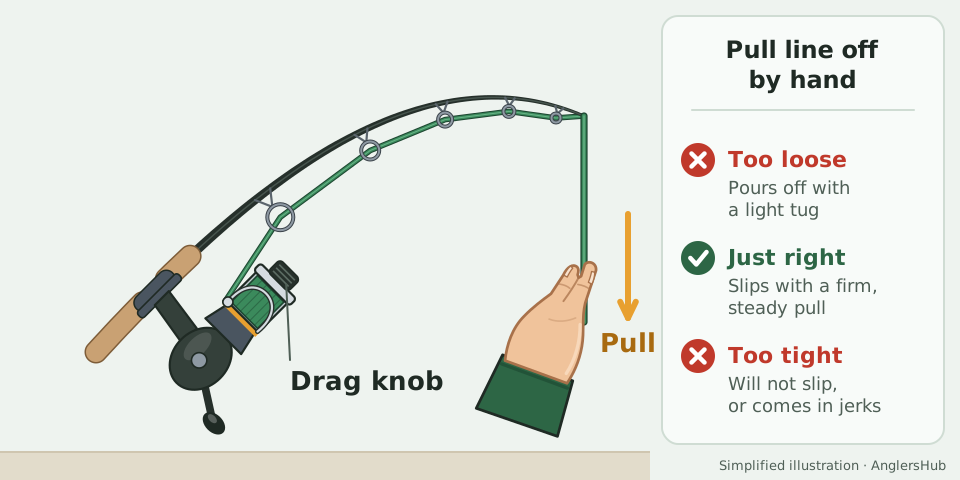
Close the bail, hold the rod up with a bend in it and pull line off the tip by hand, hard and steady. Turn the front knob until the line only slips when you really pull.
Set the freespool
Flick the freespool lever on and pull a little line off: it should run easily with a light tug. Turn the back knob until it just stops line drifting off by itself. Turn the handle once: the lever should snap off and the main drag take over.
Practise in the garden
Tie on a spring trace with no pap, hooks cut off or covered, and cast it across the lawn a few times, overhead and smooth. Feel the rod bend and the line pour off.
Most common mistake: leaving the freespool off with the bail closed while the rod sits on its rest. A carp hits the bait, the drag is locked, and your rod goes in the water. Rod on the rest means freespool on, every time.
Quick recap
- A 3.6 m (12 ft) 3 lb carp rod and a 5000 to 6000 freespool reel.
- 15 lb mono (20 lb near reeds and snags), changed every season.
- Ready-made papgooi spring traces of 40 to 60 g, snap swivels and a packet of millies.
- A 1 kg bag of mielie meal and one flavour.
- Two rod rests, a 42 inch landing net, an unhooking mat and forceps.
- Main drag set by hand, freespool just tight enough to stop drift, and freespool on whenever the rod is on the rest.
Get your kit ready
- 1Buy what is on the shopping list, or check the kit you already own against it.
- 2Spool your reel with fresh 15 lb line, to just below the lip.
- 3Set the drag by hand, then practise flicking the freespool on and off.
Finished Part 1?
Saved on this device. Create a free account to keep it on every device.
Sources for this partShow
- FAO. Common carp: natural food and feeding habits. Species profile.
- CapeNature. Angling licences. Permit page.
- Prices: a rough guide from South African tackle shop listings in October 2026. They vary by brand, shop and special.