This is where it comes together. You have the kit, the rig, the pap, a swim and a good day. Now you cast to one spot, again and again, set the rod up so it shows you a bite, and wait. When the line tears off, you have one job: stay calm and land the fish.
This part covers casting pap accurately, setting up your rod on the rests, reading a run and a drop-back, playing and netting a carp, looking after it on the bank, and what to change when nothing happens.
In 30 seconds
- Cast: a smooth overhead cast at a marker on the far bank, the same spot every time.
- Set up: rod on the rests, line just tight, hanger on, freespool on.
- Recast: fresh pap every 20 to 30 minutes in summer, every 45 to 60 in winter.
- Bite: on a run, turn the handle and lift the rod firmly. The spring has usually hooked the fish already.
- Land: rod up, let the drag work, sink the net and draw the fish over it. Then a wet mat, forceps, and back it goes.
1 spot, all session
20 to 30 min between casts in summer
Lift don't jerk
Wet mat, hands and fish
Cast to one spot
A papgooi cast is a smooth push, not a whip. Pap that is flicked hard flies off the spring, and a wild cast lands everywhere but your spot.
Line up your marker
Pick something on the far bank in line with your spot: a tree, a pole, a building. Face it square.
Get ready
Let the pap ball hang about a metre below the rod tip. Open the bail and hold the line against the rod with your index finger. Look up: no power lines, no people behind you.
Cast
Take the rod back over your shoulder, pause, then push smoothly forward with your top hand while you pull the bottom of the handle in towards you. Let go of the line when the rod points at about one o'clock.
Feather it down
Just before the pap lands, touch the line coming off the spool with a finger to slow it. The line straightens out instead of landing in a tangle on top of the pap.
Close the bail by hand
Flip the bail over by hand rather than winding it shut, and wind in any slack.
Level up: clip up. Once you have cast to your spot, put the line in the line clip on the side of the spool. Every cast after that stops at exactly the same distance. Take the line out of the clip as soon as the pap lands, every time: a carp running against a clipped line will snap it.
Feeding: the pap is your feed, so recasting is how you build the spot. If the spot is within throwing range, a few marble-sized balls of pap around it helps. Do not overdo it in cold water: you want carp to find your hookbait, not a feast.
Unlock Part 5 for free
Create a free AnglersHub account or sign in to read the rest of this part and every other part of the course. Your progress is saved to your account, so you can pick up on any device.
You come straight back to this guide afterwards.
Set up to see a bite
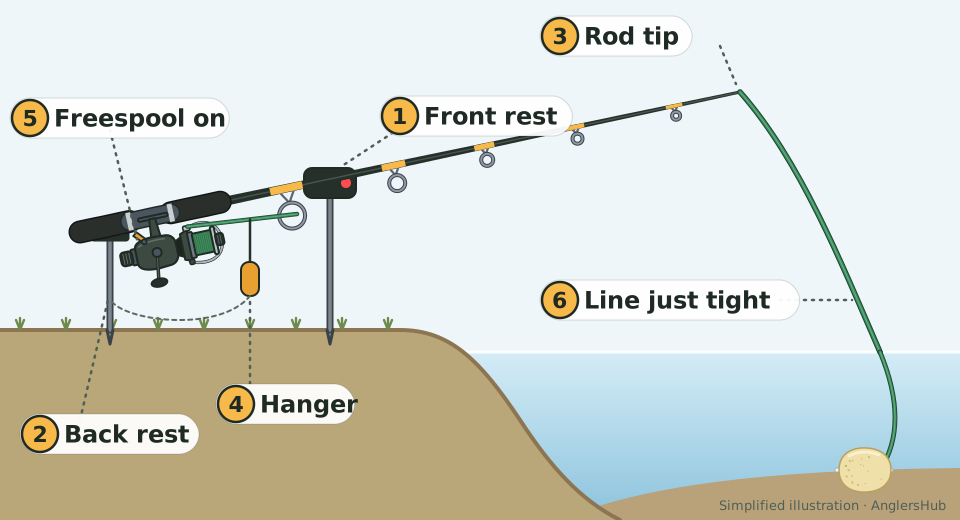
Rod on the rests
Set the front rest so the rod points towards your spot, with the tip a little up. The back rest holds the butt.
Tighten up
Wind in until the line comes straight out of the water and you feel the weight of the spring, then let a touch of line back.
Hang the hanger
Clip a hanger (or fold a small piece of foil) on the line between the reel and the front rest, so it hangs about 15 cm below the rod.
Freespool on
Flick the freespool lever on. If your reel has a clicker, switch it on too, so a run makes a noise.
A run
The hanger shoots up to the rod, the line pours off, and the alarm or clicker screams. A carp has picked up the bait and is swimming away.
A drop-back
The hanger drops and the line falls slack. A carp has picked up the bait and swum towards you, moving the spring.
Twitches
The hanger bobs and drops back. Usually a carp brushing the line, or a small fish picking at the pap. Do nothing. Get ready.
Hook it
Pick up the rod
Lift the rod off the rests with your hand on the reel. On a drop-back, wind fast until you feel the weight of the fish.
Turn the handle
One turn switches off the freespool and puts you on the main drag.
Lift, don't jerk
Sweep the rod up and back, firmly and steadily, until you feel the fish. The weight of the spring has usually hooked the carp already. A wild strike only rips the hook out.
Most common mistake: grabbing the reel handle while line is pouring off with freespool on, then striking hard. Pick up, one turn, then lift. Slow and firm lands more carp than fast and hard.
Play it
- Rod up, at about 45 degrees, with a good bend in it. The bend is the spring that keeps the hook in.
- Let the drag work. When the carp runs, let it take line. Do not wind while line is going out: it only twists the line.
- Pump and wind. When the fish stops, lift the rod slowly to gain a metre, then wind as you lower it. Repeat.
- Steer with side strain. If it heads for reeds or a snag, swing the rod low to the opposite side and pull it away.
- Be patient near the bank. A carp makes its strongest runs when it sees you or the net. Let it go, then bring it back.
Tip: a bigger carp can take ten minutes or more. Do not tighten the drag to hurry it. If it is taking too much line near a snag, press a finger lightly on the spool instead, and let go if it lunges.
Net, unhook and return
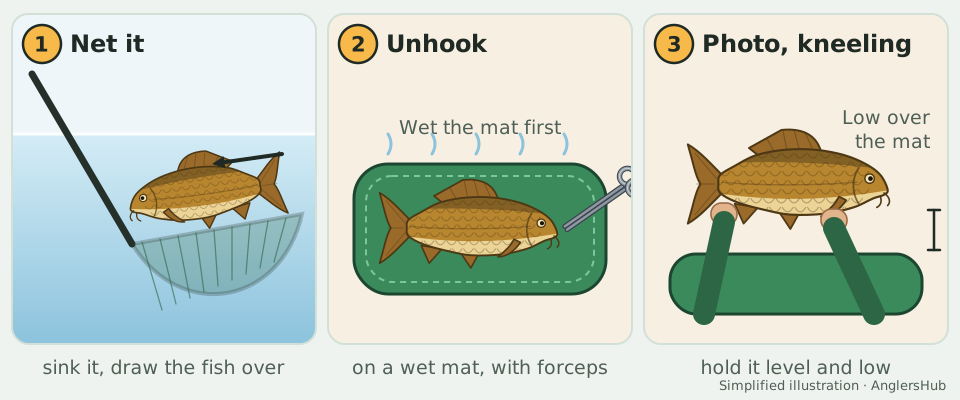
Sink the net
Put the net in the water early and keep it still. Do not chase the fish with it.
Draw it in
When the carp is tired and on its side, lead it head first over the net, then lift the arms until the fish drops in. If it turns away, let it go and try again.
Rest it
Leave the fish in the net in the water for a moment while you wet the unhooking mat. Push the arms of the net together, then lift it by the frame, not just the handle.
Unhook on the mat
Lay the fish on the wet mat in the folds of the net. Hold the hook with forceps and push it back out the way it went in.
Photo, kneeling
Wet your hands. Kneel over the mat and lift the carp level, one hand under the front fins and one near the tail. Never stand up holding it: a dropped carp is a hurt carp.
Back it goes
Carry it to the water in the net or on the mat, hold it upright in the water and let it swim off on its own.
Keep it wet and quick. Keep a carp out of the water for as short a time as you can, and pour water over it if you need a moment. In hot weather, be faster still.
No runs? What to change
Nothing after an hour
Reel in and check: is the pap still on, are the hook links tangled, are both millies still on? Then recast to the same spot, more often.
Nothing after two hours
Look for signs again, and move closer to them: try the reed margin or the bottom of the drop-off, or try the windy bank.
Bleeps but no runs
Fish are there. Try a different millie colour, or a softer pap that breaks down faster.
Level up: keep it quiet. Carp hear far better than bass. Footsteps, banging bank sticks in and car doors carry through the water, especially in the margins. Set up a few metres back from the edge and move softly.
Level up: change one thing at a time. If you fish two rods, put a different millie colour or a different spot on each. When one rod starts producing, switch the other over.
You caught it. Now log it.
Your first carp is a big moment. Log it on AnglersHub with the dam, the weight if you weighed it, the bait and the time. You only catch your first once, and your log turns into your own record of what works on your water.
Quick recap
- One spot, lined up with a far-bank marker, cast smoothly and feathered down.
- Rod on the rests, line just tight, hanger on, freespool on.
- Fresh pap every 20 to 30 minutes in summer, every 45 to 60 in winter.
- On a run: pick up, one turn of the handle, then lift firmly.
- Rod up, let the drag work, sink the net and draw the fish over it.
- Wet mat, forceps, a kneeling photo, and back in quickly.
Go catch it
- 1Cast to one spot and recast with fresh pap every 20 to 30 minutes.
- 2When the line runs, engage the reel and lift the rod into the fish.
- 3Log your first carp on AnglersHub. You only catch your first once.
Finished Part 5?
Saved on this device. Create a free account to keep it on every device.
4 parts left to finish
Sources for this partShow
- Beukema, J.J. (1970). Angling experiments with carp: decreasing catchability through one-trial learning. Netherlands Journal of Zoology.
- Lovén Wallerius, M. and others (2020). Hook avoidance induced by private and social learning in common carp. Transactions of the American Fisheries Society. Read the paper (PDF).
- Carp hearing: carp have Weberian ossicles linking the swim bladder to the inner ear, giving them much wider hearing than bass. See the AnglersHub Science of Summer Carp Fishing (Pro).
- Landing and handling methods: standard carp angling practice used at South African carp venues.