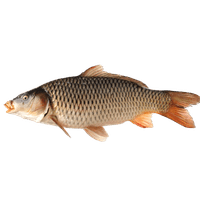
A carp cannot make its own body heat. The water sets its temperature, and its temperature sets how hungry it is. Pick a warm day in the right season, sit at the right time of day with the wind on your bank, and your first carp gets a lot closer.
This part covers the carp year in South Africa, the water temperatures to look for, the best times of day, the weather that helps and hurts, and how to plan a session.
In 30 seconds
- Best months: November to April on most inland dams, with autumn (March to May) the classic time for big fish.
- Best water: 18 to 26 °C. Carp feed best in the low to mid 20s.
- Summer: dawn, dusk and night. Winter: the warmest part of the afternoon.
- Weather: a warm, steady wind and stable or falling pressure. Slow after a cold front.
- Plan: at least four hours, through dawn or into dusk, with the pap made the night before.
18 to 26 °C prime water
Nov to Apr best months inland
4 hours+ a good first session
Dawn and dusk in summer
The carp year in South Africa
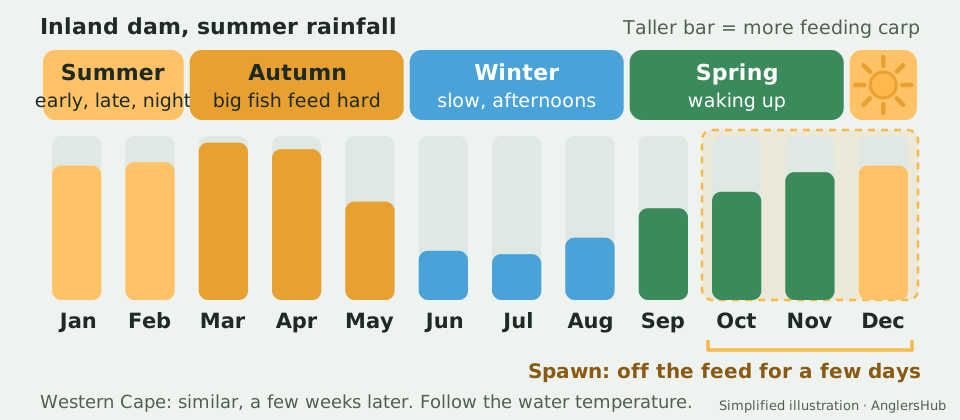
Spring (Sep to Nov): waking up
Water warms past 15 °C and carp start feeding properly. Fish warm, shallow bays and the windy bank on sunny days. Bait little and often.
Summer (Dec to Feb): peak appetite
Carp are hungry, but hot, bright middays are slow. Fish dawn, dusk and night, and windy or cloudy days. Recast often: they clear pap fast.
Autumn (Mar to May): big fish time
Water is still warm and carp feed hard before winter. Often the best fishing of the year, all day long.
Winter (Jun to Aug): slow but possible
Carp eat little below about 12 °C. Fish sunny afternoons in the shallows, use small balls of pap and bright millies, and be patient.
The spawn
When the shallows pass about 18 to 20 °C in late spring, carp spawn. On most Highveld dams that is somewhere between October and December. You will see them splashing and chasing in shallow, weedy margins. Spawning carp ignore bait for a few days, so fish away from that area, or come back a week later. After spawning they feed heavily to recover.
Unlock Part 4 for free
Create a free AnglersHub account or sign in to read the rest of this part and every other part of the course. Your progress is saved to your account, so you can pick up on any device.
You come straight back to this guide afterwards.
Water temperature
Water temperature, not air temperature, is what matters. A 34 °C afternoon may only mean 26 °C water, and a frosty dawn can still have 14 °C water under it. The water estimate on the Weather Hub is a good guide.
Under 12 °C: slow
Carp barely feed. Small pap, one bright bait, the warmest afternoon hours.
12 to 18 °C: waking up
Feeding picks up as the water warms. Sunny banks and shallow bays first.
18 to 26 °C: prime
Carp feed hard for much of the day. Bait well and recast often.
Over 26 °C: early and late
Daytime feeding slows. Fish dawn, dusk and night, the windy bank and inflows.
Myth: carp do not bite in winter.
Fact: they bite, just less. Carp have no stomach and a slow body in cold water, so they eat small amounts. Scale down: a smaller ball of pap, fewer casts, a bright pink or white millie on each hook, and fish from late morning to late afternoon.
Time of day
- Summer: first light to about 09:00, and from about 16:00 into dark. Carp often feed best at night in summer, if the venue allows night fishing. Midday in the heat is slow, unless it is windy or overcast.
- Spring and autumn: carp can feed all day. Mornings and late afternoons are usually best.
- Winter: the warmest hours, roughly 11:00 to 16:00, especially on calm, sunny days after a few mild days in a row.
Tip: carp often feed in a "window" of an hour or two, then go quiet. Be fishing, with fresh pap out, before the window starts. Arrive before dawn, rather than at dawn.
Weather
Good signs
A warm, steady wind blowing onto your bank. Overcast, mild days. Several days of stable, warm weather. Rising water after good rain, which floods fresh ground at the edges.
Hard days
Bright, cold, still days after a cold front. Sudden drops in water temperature. Hot, still days with green water, when oxygen runs low.
Leave at the first thunder. A 3.6 m carbon rod is a lightning conductor. Pack up when you hear thunder, not when the rain starts. Also look up before every cast: never fish under or near overhead power lines.
Level up: keep notes of every session: water temperature, wind direction, pressure and the time of each bite. Your catch log does this for you. After a season you will see your dam's own patterns, and they beat any rule of thumb.
Plan your session
Carp fishing is a waiting game. You build up a spot with pap and give the carp time to find it, so give yourself at least four hours, through dawn or into dusk.
Check the forecast
Open the Weather Hub for your dam. Look at the Bite Score, the water temperature and the wind direction, and pick the bank the wind will blow into.
Make the pap the night before
Cook and knead a batch (Part 2) and keep it in a sealed bag in the fridge. Check three or four spring traces while it cools: sharp hooks, straight hook links.
Pick your window
In summer, be set up before first light or from late afternoon. In winter, aim for late morning to late afternoon.
Tell someone
Tell someone where you are going and when you will be back. Take water, a hat and sunscreen, and something warm for the evening.
Pack list
- Rod and reel, spring traces, snap swivels and millies.
- Pap in a sealed bag, your flavour, and a cloth or bucket of water to rinse your hands.
- Rod rests, landing net, unhooking mat and forceps.
- Licence or day ticket, phone, water, hat, sunscreen, a chair and a warm top.
Quick recap
- Best months inland: November to April. Autumn is big-fish time; winter is slow but possible.
- Look for water of 18 to 26 °C. Carp go off the feed for a few days while they spawn.
- Summer: dawn, dusk and night. Winter: the warmest afternoon hours.
- A warm wind on your bank is the best weather sign. Leave at the first thunder, and never fish near power lines.
- Plan at least four hours, with the pap made the night before.
Plan your session
- 1Check the Weather Hub and Bite Score for your dam.
- 2Pick a day and a session of at least four hours, through dawn or into dusk.
- 3Make your pap the night before and pack the list at the end of this part.
Finished Part 4?
Saved on this device. Create a free account to keep it on every device.
Sources for this partShow
- FAO. Common carp: natural food and feeding habits (feeding slows below about 15 °C, nearly stops below about 8 °C, best growth at 20 to 25 °C). Species profile.
- Oyugi, D.O., Cucherousset, J., Baker, D.J. and Britton, J.R. (2012). Effects of temperature on the foraging and growth rate of juvenile common carp. Journal of Thermal Biology 37(1): 89 to 94. Record.
- Ellender, B.R., Weyl, O.L.F., Winker, H. and Booth, A.J. (2010). Quantifying the annual fish harvest from South Africa's largest freshwater reservoir. Water SA 36(1). Record.
- AnglersHub. The Science of Summer Carp Fishing in South Africa (Pro).