A papgooi setup has three parts: a spring trace that carries the pap out and holds two hooks, millies (soft floats) on the hooks, and the pap itself, which brings the carp in. Get all three right at home and the bank is easy.
This part shows how a spring trace works and how to tie it on, how to bait the hooks, how to cook and knead a batch of pap, and how to mould it so it stays on through a hard cast and breaks down on the bottom.
In 30 seconds
- Spring trace: a ready-made trace of 40 to 60 g with two hooks. Tie a snap swivel to the end of your main line with a Palomar knot and clip it to the swivel at the end of the trace.
- Millies: push one soft float onto each hook, with the point and barb showing.
- Pap: cook mielie meal stiff with water and flavour, cool it, then knead in dry meal until it feels like play dough.
- Mould: press a lump a bit bigger than a golf ball round the spring, squeeze it smooth, and push the two baited hooks just into the outside.
- Test: it must stay on through a hard swing and start breaking up in a bucket within 10 to 20 minutes.
40 to 60 g spring trace
2 hooks, a millie on each
About 1 kg mielie meal a batch
10 to 20 min to break down
The spring trace
A spring trace is the classic South African papgooi rig, and every tackle shop sells them ready-made. A wire spring with a lead weight sits in the middle: the pap is moulded round it, and the lead takes it out on the cast and holds it on the bottom. A short hook link comes off a swivel at each end, so you fish two hooks round one ball of pap.
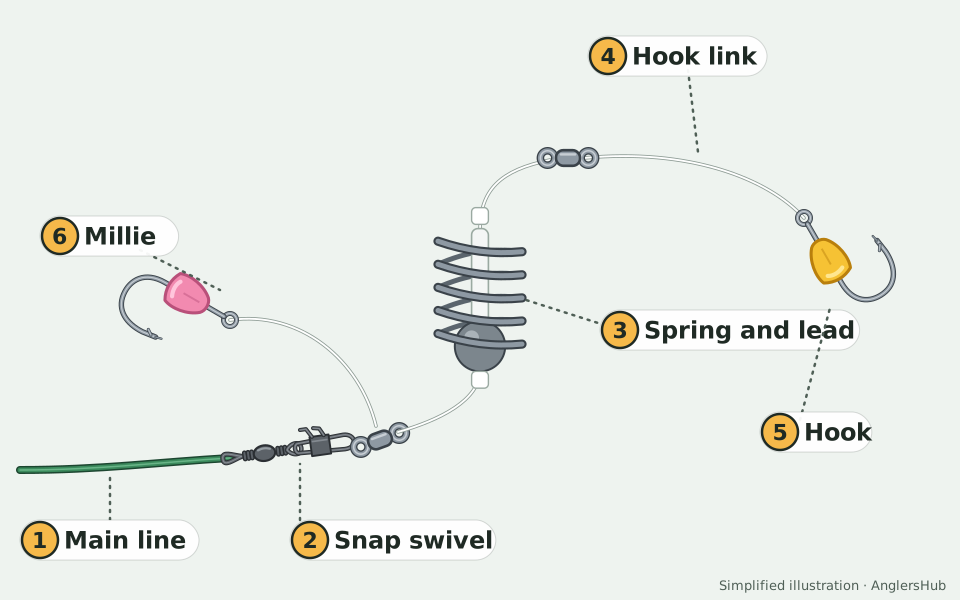
Check three things on a packet trace before you buy: the weight suits your dam (40 g for small dams, 60 g for wind and long casts), the hooks are sharp and not rusty, and the hook links are not kinked or tangled.
Myth: a bigger hook catches bigger carp.
Fact: carp hooks stay small. A size 8 is light enough for a carp to suck in with a millie and strong enough to land a 10 kg fish. A big, heavy hook drags the millie down, so it does not float or move like the food around it.
Unlock Part 2 for free
Create a free AnglersHub account or sign in to read the rest of this part and every other part of the course. Your progress is saved to your account, so you can pick up on any device.
You come straight back to this guide afterwards.
Bait the hooks with millies
A carp feeds by sucking food into its mouth, tasting it, and blowing out anything that feels wrong. A millie is a soft foam float shaped like a mielie pip. It floats the hook just off the bottom, right over the feed, where a grubbing carp sucks it in with the pap. When the fish moves off, the weight of the spring pulls the hook into its lip.
Pick your colours
Yellow and white look like mielie pips. Pink and orange stand out on a dirty bottom. Start with one yellow and one pink, one on each hook.
Push it on
Push the hook point into the side of the millie and thread it round the bend, so the millie sits on the shank.
Leave the point clear
The point and barb must stick out of the millie. A buried point does not catch the carp's lip.
Tip: squeeze a millie in your fingers and dip it in your flavour before you push it on. It soaks some up and smells like the pap around it.
Level up: tie your own traces. Once you are catching, buy springs and leads and tie your own hook links of 15 lb mono about 10 to 15 cm long, with size 8 hooks. It is cheaper, and you can replace a blunt hook without throwing away the whole trace.
The papgooi rig: putting it together
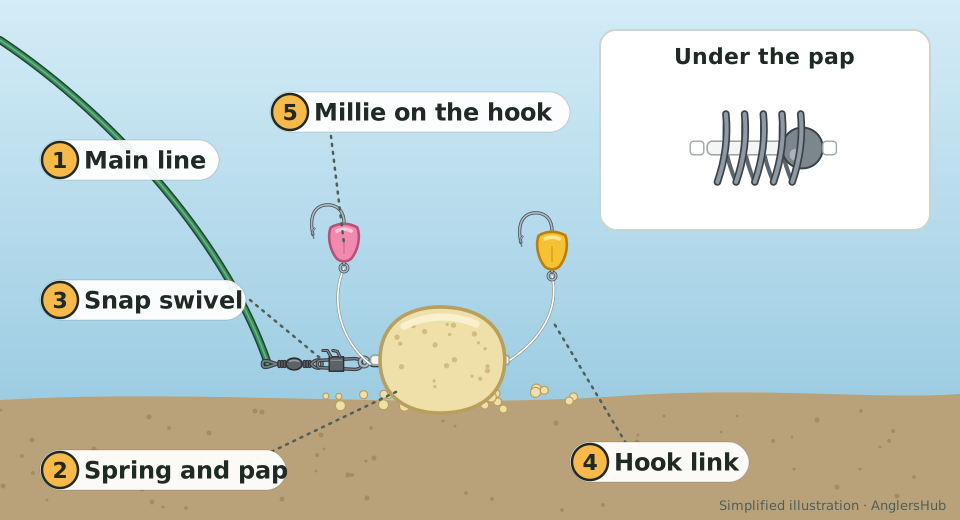
Out on the bottom, the pap slowly breaks down round the spring. The millies float the two hooks just above the feed. When a carp sucks one in and swims off, it feels the weight of the spring, bolts, and hooks itself. That is why papgooi anglers do not strike hard: the spring has already done most of the work.
Tie on a snap swivel
Tie a snap swivel to the end of your main line with a Palomar knot. Wet it, pull it tight and trim the tag.
Clip on the trace
Open the snap, hook it through the eye of the swivel at the end of the spring trace, and close it until it clicks. Give it a pull to check.
Straighten the hook links
Run each hook link between your fingers to take out kinks from the packet.
Bait the hooks
Push a millie onto each hook, point and barb showing.
Add the pap
Mould the pap round the spring (see below) and push the hooks just into the outside.
Use a strong knot and good line. A carp that breaks you off is left trailing a spring and two hooks. Tie a fresh Palomar knot every session, check the last metre of line for nicks, and set your drag by hand as in Part 1.
Cook the pap
Good papgooi pap is cooked, cooled and then kneaded stiff with extra dry meal. Cooking makes it sticky enough to hold together, and kneading makes it firm enough to cast. Make it the night before, so it is cool when you go.
Boil the water
Bring 1 litre of water to the boil in an old pot. Add your flavour (follow the bottle, usually a capful or two) and, if you like, two tablespoons of sugar.
Stir in the meal
Turn the heat down. Pour in mielie meal a cup at a time, stirring hard, until the pap is too stiff to stir easily. It takes most of a kilogram.
Steam it
Put the lid on and let it steam on low for about 20 minutes, turning it once or twice so it does not burn.
Cool it
Tip it into a plastic bag or a bowl and leave it until you can handle it comfortably.
Knead in dry meal
On a clean surface, knead in handfuls of dry mielie meal for about 10 minutes, until it is firm, smooth and no longer sticks to your hands, like play dough.
Bag it
Seal it in a plastic bag and keep it cool. It keeps for a day or two in the fridge. At the dam, keep the bag in the shade or a cooler box so it does not dry out.
Not keen on cooking? A bag of ready-made papgooi mix from the tackle shop only needs water and kneading. Follow the packet, then do the bucket test below the same way.
The bucket test
Before you go, mould pap onto a spring (see below), swing it hard a few times as if you are casting, then drop it into a bucket of water and watch.
Falls off on the swing
Too soft or too sticky. Knead in more dry meal until it is firmer.
Holds, then breaks up in 10 to 20 minutes
Just right. It lands in one piece and slowly turns into a pile of food round your hookbait.
Still a hard ball after an hour
Too hard. Knead in a little water, or use less dry meal in the next batch.
Level up: break-down speed. In cold water, carp eat less and pap breaks down more slowly, so make it a touch softer and use a smaller ball. In summer, with lots of fish around, a firmer pap that lasts longer keeps them grubbing in your spot.
Mould the pap onto the spring
Take a lump
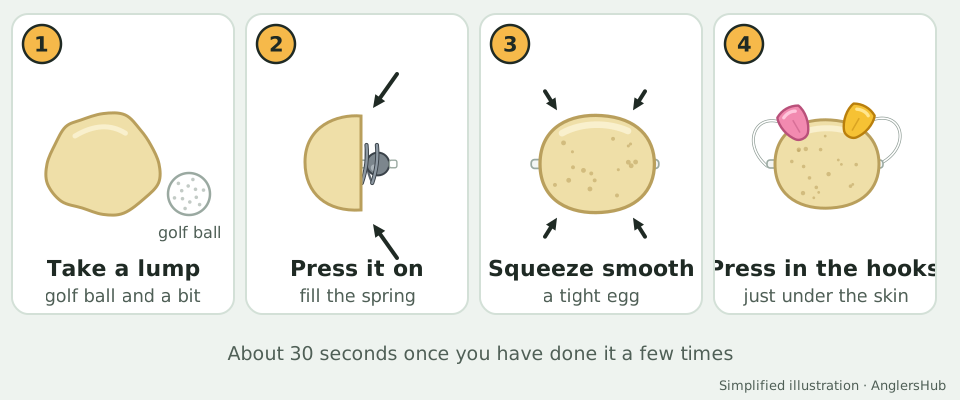
Pinch off a lump a bit bigger than a golf ball. Use a little more on a 60 g spring, less in winter.
Press it on
Push it round the spring so it fills the gaps between the coils and covers the spring completely, end to end.
Squeeze it smooth
Close your hand round it and squeeze firmly a few times, turning it, into a smooth egg shape. Any cracks will open up on the cast.
Press in the hooks
Push each baited hook just under the skin of the pap, one on each side, with the millie sitting on the outside. This stops the hook links tangling on the cast. As the pap breaks down, the millies pull the hooks free and float them over the feed.
Most common mistake: pushing the hooks deep into the middle of the ball. They stay trapped until the whole ball has broken down, and you miss the carp that come in early. Just under the skin is enough to hold them for the cast.
Quick recap
- A ready-made spring trace of 40 to 60 g with two hooks, tied to your main line with a Palomar knot.
- A millie on each hook, with the point and barb showing.
- Pap: 1 litre of water, flavour, about 1 kg of mielie meal, steamed 20 minutes, cooled, then kneaded with dry meal until it is like play dough.
- Bucket test: stays on through a hard swing, breaks up in 10 to 20 minutes.
- Mould a lump a bit bigger than a golf ball round the spring, squeeze it smooth, and push the hooks just under the skin.
Rig up and mix
- 1Tie a snap swivel to your main line, clip on a spring trace and put a millie on each hook.
- 2Cook a batch of pap and test a moulded spring in a bucket of water.
- 3Mould the spring five times, until it takes you under a minute.
Finished Part 2?
Saved on this device. Create a free account to keep it on every device.
Sources for this partShow
- FAO. Common carp: natural food and feeding habits (suction feeding and sorting food in the mouth). Species profile.
- Sibbing, F.A., Osse, J.W.M. and Terlouw, A. (1986). Food handling in the carp: its movement patterns, mechanisms and limitations. Journal of Zoology.
- Lovén Wallerius, M. and others (2020). Hook avoidance induced by private and social learning in common carp. Transactions of the American Fisheries Society.
- Rig and pap methods: standard South African papgooi practice, as taught by tackle shops and carp clubs.